Monday, July 18, 2016

Remembering sloughs

Surrounded by trees, bush and full of plant growth, Beaver Lake in Stanley Park reminded me of the prairie sloughs of my childhood.

But no, we didn't have pink and white water lilies like Beaver Lake has, and if there were ducks, they weren't as tame as the ones in Stanley Park.

Around the edges of the lake is the kind of natural growth that reminds me of  the prairies.

Cattails add to the atmosphere of a wild lake in the middle of the park.

Clear water at the edges of the lake made me want to dip my toes in.

My friend Ros thought some of the weedy growth near the lake was intriguing. A check online makes me think she was holding a type of sedge.

One of the best times of the year for prairie farm kids like us was slough season. That's when melting winter snow turned low-lying spots into mini-lakes, a rare and wonderful phenomenon in a dry landscape where real lakes were few and far between, and the ocean unthinkable.

To kids whose main experience of water was a few inches in the bathtub once a week, a whole body of it was magical. So what if it lasted only weeks, months at best? So what if the cows created shifting shades of yellow and brown in it? You could put on your rubber boots and wade through it. You could admire the things floating in it, and you could see right through it to the bottom. But mostly, you could build a raft and try to propel it through the water with tree-branch poles. Inevitably, it would start to sink. Then you would stand on one end to try to keep afloat, awaiting with thrilled dismay the coming shock of cold water.

Now the ocean is a 30-minute walk from my front door, and after four decades, it is still exciting to look down the Dunbar hill and see giant freighters at anchor. But a visit to Stanley Park's Beaver Lake on Monday reminded me of prairie sloughs, and how a little body of water gave such pleasure to me and my siblings. Beaver Lake is much bigger and more picturesque, with ducks bobbing among nearly solid mats of pink and white water lilies. But the trees and the bush that circumscribe it, the cattails and weedy brush on its shores, gives it the natural feel of the sloughs I grew up with.

All I really wanted to do was build a raft and feel it slowly sink beneath my feet.

Sunday, July 17, 2016

The serenity of clean

It was time for a big house cleanup this weekend, including washing a year's worth of grime off the windows. Unfortunately, with windows of our vintage, some water always leaks through. Towels mop up the damage. Our cleanup enterprise made me think of how different a clean and orderly house feels -- something the Bronte sisters knew way back in the 1830s.


John takes the brush to the basement windows. Cleaning them brought a whole new world of brightness into the basement.

The finished product would have pleased even the cleanliness-obsessed Bronte sisters.
 Saturday was cleanup day in our household, and as I polished windows and washed floors, I was thinking about household work and about how a clean and orderly house makes us feel.

Nobody appreciated cleanliness and orderliness more than the Bronte sisters, who are in my thoughts because I have been reading their works this summer; right now I'm in the middle of Elizabeth Gaskell's The Life of Charlotte Bronte.

Charlotte, Emily and Anne were poor, shy, unqualified to do anything useful in the world, and desperately wanting to write at a time when women writers were discouraged. Brought up in simplicity, humility and religion, their biggest desire was to stay home in their father's Yorkshire parsonage, with the lonely moors and each other as company, and to spin their rich imaginings into books.

Although as parson's daughters they were above the servant class, economy forced them to learn all the household tasks. And when they lost their longtime servant to age and disability, they took over all the work themselves. "I have lately discovered I have quite a talent for cleaning, sweeping up hearths, dusting rooms, making beds &; so, if everything else fails, I can turn my hand to that, if anybody will give me good wages for a little labour," wrote Charlotte in 1839, before she became the acclaimed author of Jane Eyre, Villette and The Professor.

The Brontes' books reveal an ardent appreciation for well-kept surroundings, whether in grand country houses or in frugal apartments, especially if a cat and a blazing fireside is involved. Here's Charlotte's hero in The Professor seeing his poverty-stricken beloved's tiny apartment for the first time: "Stepping over a little mat of green wool, I found myself in a small room with a painted floor and a square of green carpet in the middle; the articles of furniture were few, but all bright and exquisitely clean: order reigned through its narrow limits; such order as it soothed my punctilious soul to behold..." (The cat and fireside soon make an appearance.)

The key words in the preceding passage are, "soothed my punctilious soul." Women like the Brontes, with their high-pitched imaginations, high fear levels and high standards, probably did find cleanliness and order calming and soothing.

I felt a touch of that yesterday myself. When our house was clean and the windows, after a year's neglect, were finally so clean they seemed to vanish altogether, the whole world seemed more orderly and serene.

Here are a couple of excerpts showing Charlotte Bronte's enthusiastic appreciation of beautifully arranged and maintained living spaces:

Thornfield Hall is made ready for guests:
"...carpets were laid down, bed-hangings festooned, radiant white counterpanes spread, toilet tables arranged, furniture rubbed, flowers piled in vases: both chambers and saloons looked as fresh and bright as hands could make them. The hall too, was scoured; and the great carved clock, as well as the steps and bannisters of the staircase, were polished to the brightness of glass; in the dining room, the sideboard flashed resplendent with plate; in the drawing-room and boudoir, vases of exotics bloomed on all sides." (p. 174, Jane Eyre)

Lucy Snowe gets her reward:
"Opening an inner door, M. Paul disclosed a parlour, or salon -- very tiny, but I thought, very pretty. Its delicate walls were tinged like a blush; its floor was waxed; a square of brilliant carpet covered its centre; its small round table shone like the mirror over its hearth; there was a little couch, a little chiffonniere -- the half-open, crimson-silk door of which, showed porcelain on the shelves; there was a French clock, a lamp; there were ornaments in biscuit china; the recess of the single ample window was filled with a green stand, bearing three green flower pots, each filled with a fine plant glowing in bloom. . . . The lattice of this room was open; the outer air breathing through, gave freshness, the sweet violets lent fragrance." (p. 452-3, The Professor)

Saturday, July 16, 2016

Next school year...

Woolf, Marx and Balzac, or forgiveness and apologies? Where will my head be when September begins and I start my third year of graduate liberal studies at Simon Fraser University?

A Friday-night preview of the courses being offered in the 2016-17 school year showcased a very excellent professor offering a course called "Mercy and Regret: An Inquiry into the Nature of Forgiveness and Apologies." Is there such a thing as forgiveness? Are apologies worth anything? He posed some interesting ideas, but unfortunately (in my view), the course looks heavy on philosophy and light on literature, so I will likely give it a miss.

Instead, I will likely be tracing major shifts in the western tradition, hopping from the Renaissance to the Enlightenment, to the Industrial Revolution, through feminism and into colonization and its downfall. The authors include Kant, Marx, Woolf and Balzac, as well as Rachel Carson (Silent Spring) and Pope Frances (encyclical on the environment and the economic system.) It sounds like a good solid survey course, filling in some of my knowledge gaps. Not exciting, but I have a lot of gaps to fill.

In the spring of 2017, there's a real downer of a course called "Apocalypse Now (and Then)" -- a survey of dystopian literature over the last 100 years, including authors like Conrad, Huxley and Atwood. All people I shy away from because of their sheer depressingness. The other choice is "Sex and Gender in the North American Sixties: Cold War to Counterculture and Beyond." Hmm. Not sure if I'm ready to revisit women's liberation, the Vietnam War and the hippie era. It seems so ... close.

One of the more interesting ideas is a concentrated, six-week "travel study" course, but in Vancouver. The prof is trying to replicate the atmosphere of the travel study courses the university offers to places like Rome, but situating it instead in our home town. It will be focused on arts -- music, dance, theatre, etc. -- and students will go to performances, museums and galleries. The idea is they will learn to better understand and critique all these different art forms. Kind of like going to university to learn how to be an art critic!

The good thing? There are still six precious weeks of summer left before I load up my books and become a student again.

Thursday, July 14, 2016

Three inches of hedge too much

Is our little boxwood hedge interfering with pedestrians? An anonymous local character -- who has made 400 complaints to the city  so far this year about sidewalk encroachments -- apparently has us on his list.  On Thursday we got a notice from the city to cut our hedge back. 

After a similar complaint last year, we took out some overgrown laurels and planted a few new boxwoods to continue the small hedge. They are still struggling to get established. 
My friend Linda has fun with an overgrown laurel hedge elsewhere in the city. Yes, it does need cutting back.

A  blackberry vine -- very thorny -- dangling over the sidewalk brings out the actress in Linda, who mimes what would happen if someone ran into it. 

I think flowers that add beauty and colour to our sidewalk experiences should be given some leeway under city rules. 
I expect our angry neighbour would want even these small flowers chopped back. 
A few days ago, I wrote about our neighbour Audrey getting a notice from the city to cut back her beautiful, widely admired plantings because they were extending onto the sidewalk. Thursday morning, it was our turn.

An apologetic orange-vested city worker rang our doorbell and handed us a notice saying our little boxwood hedge is "interfering with the use of the city sidewalk." We must cut it back before Aug. 13 or the city will do so at our expense.

The same thing happened last year, but that time around, it was justified. Some laurels had gotten way overgrown, so we took drastic measure, and this year, you'd have to squint hard to find a problem. A tape measure just might find the boxwood about three inches over the sidewalk in some places. Normally, that would have been taken care of by now, but a health problem forced our tree trimmer to delay his usual work this year.

In our conversation with the city worker, he told us that of the 800 complaints of this kind in the city's west side so far this year, 400 -- yes, fully half! -- have come from one man. It seems we have a neighbour who patrols the area assiduously, looking for violations.

When I asked the worker, who is with the street operations branch of the city's engineering service, whether this interferes with his other duties, he said it takes up a lot of the time he should be spending on other things. Which made me think of the cracked and bumpy sidewalks that made it a Herculean effort to take mom for a walk when she was blind and using a walker.

Later during a walk with my friend Linda elsewhere in the city, we started noticing all the plants encroaching on sidewalks. A laurel hedge that took up about one-third of the sidewalk and a thorny blackberry vine dangling in the path of passersby definitely needed my grumpy neighbour's attention. But we thought lavender and flowers growing a few inches over the sidewalk should be left alone. They soften the city's hard edges and add character, beauty and scent without impeding anyone.

There is such a thing as discretion and good sense, and it seems wrong for city workers to have to spend their time handing out sheaves of notices about trivial encroachments when they know there's more serious work to be done. Since when should one angry man be allowed to dictate what city workers do?

The downsides of going fake

This might look like an ordinary lawn and boulevard, but it's all fake grass.  Health and environmental officials are raising concerns about the increasing move toward artificial turf, and its impacts on humans and on the environment. 

Real boulevard grass to the left; artificial grass to the right. The leaves fall equally on both. 

Another house with artificial turf. Rocks on the boulevard  ensure there is no lawn mowing on this property! 

Or, you can go another route. This beautiful piece of landscaping has no grass, but lots of  drought-resistant plants like lavender, grasses and  verbena. 

Another property where eye-pleasing alternatives have been found to traditional lawns.


The house is modern, and the non-traditional plantings fit right in.

All the grass has been replaced by a masses of drought-tolerant plants at this little cottage.

There is no room on either side of the sidewalk for regular grass on this colourfully planted property. 

I stopped in my tracks during a recent walk with an abrupt feeling that something wasn't right. It took a few minutes to figure it out. It was the grass. The lawn around the house I was passing was smooth, green, perfect, divided by wooden borders into sections, like rugs stretched out for display.

On one side of the wooden barriers was reality -- scruffy, weedy grass with soil showing through. On the other side was perfection -- the thick, even greenery of artificial grass.

An earlier news headline about hordes of homeowners tearing out their lawns and installing artificial turf leapt to mind. A great solution to climate change, they rhapsodized -- not only would it save water, but it would reduce pesticide use. Plus guarantee a perfect lawn year-round with no mowing or maintenance.

Why was my first reaction to remember K-Cups? At a time when we all knew about the huge plastic island in the middle of the ocean, we were enthusiastically agreeing to add to the plastic problem with every coffee we drank. As for artificial grass, no matter how much water it saved, could it be good for large numbers of houses to have big plastic mats around them? How would it affect earthworms and bugs that live in the soil? How about the birds that live on them?

Turns out that yes, there are concerns. "Artificial turf acts and behaves like any other paved surface," Ronald Macfarlane, a public health manager for Toronto, told The Huffington Post in a June 2015 story. "It gets very hot in the sun." Hot plastic can release toxic chemicals into the air. And hot plastic, like concrete, can raise local air temperatures by several degrees. Manufacturers recommend watering it to cool it down -- as well as to remove animal pee and poop -- reducing its water-saving advantages. It's perforated, but rain goes through slower than in regular grass, which can cause flooding. It can even contribute to climate change, as it doesn't have the air-purifying effects of plants and lawns, which take in carbon dioxide and release oxygen.

Experts recommend that anyone wanting to get rid of their grass lawn turn to natural landscaping and drought-friendly plants. In my travels around the city, I see many people using imaginative -- often much more beautiful -- alternatives to traditional lawns.

For those who insist on going the fake grass route, I turn to a naughty suggestion from my sister-in-law Wendy. "What would happen," she asked, "if you took dandelion seeds and blew them onto an artificial lawn?' Perhaps if we added a handful of dirt, we could bring nature back.

Tuesday, July 12, 2016

Hydrangeas

In the spring, rhododendrons and azaleas are the workhorses of Vancouver's gardens, parks and boulevards, with the different varieties providing months of changing shapes, scents and colours.

In the summer, hydrangeas take over. Like rhodos, hydrangea varieties can look so different that it's hard to believe they all belong to the same species. Most common are the mopheads -- those big pom-pom flowers that are everywhere, mainly in blues, pinks, purples and whites. I have a sneaking preference for the lacecaps, with their tightly curled centres and outer rims of open petals. I can imagine them as a cap on an old-fashioned head, with the petals serving as lace around the face. Then there are the climbing hydrangeas, which seem to put up with any amount of pruning, sprinting up my garage walls as high as I will let them go.

I've always had good luck with hydrangeas, probably because they do well in the shade, and my garden has plenty of that. However, they do tend to get leggy and flop over under the weight of their blossoms, probably a pruning issue. As their name (hydra) suggests, they need lots of water, so they may not be the best plants to choose if climate change brings us dryer summers. But this year's moderate weather has been kind, and my hydrangeas and the many I encounter in my walks all seem to be thriving. Here are some of the hydrangeas I've been enjoying this summer:

Pink and purple hydrangeas through the window of the Ferry Gallery in West Vancouver are a nice foreground to the green lawn and the ocean beyond. 

These are my neighbour Audrey's oak-leaf hydrangeas. They got her into trouble because they grow so vigorously under her extremely green thumb that they are spilling over onto the sidewalk. Someone complained, and the city has ordered her to cut them back.

I liked this cheerful display of  blue mophead hydrangeas contrasted against the trunk of a cherry tree.

These are mopheads in my garden. They start out white but change to various colours as they age. What's interesting is that one blossom will turn one colour and another a different one, seemingly for no reason. One of these blossoms seems to be going pink and the other purplish blue.

These are lacecaps in my front garden. One blossom is more pinkish purple, the one beside it more blue. Who knows why?

I always admire this long planting of white mophead hydrangeas when I walk past it in the Kerrisdale area. Somebody knows how impressive mass plantings can be!
This garden is a study in blue, with thyme blooming on the ground and blue hydrangeas acting as a backdrop.

Another lacecap from my front garden, this one blue and white. 

My boxwood hedge acts as a nice frame for the hydrangeas bursting over its top.
My sister Diane admired this bouquet and was interested to learn it was mainly lacecap hydrangeas.She always said she didn't like hydrangeas, but her previous experience was with mopheads. She may change her mind about planting hydrangeas in the future.

Monday, July 11, 2016

That racism thing

Is it racist to talk about the money behind the flood of new construction in Vancouver? This house, which is allegedly being renovated but looks like a complete new build, is on a corner lot in Point Grey. Across the street, two new  houses, a laneway house and a garage are all being built. Many houses in this area have already gone through the process and are brand new. Many are vacant.

A common scene on Vancouver's west side. An empty lot awaits builders, while a small house on an adjacent lot awaits demolition day. In some west side areas,  houses that are occupied and not for sale or being demolished are almost a rarity.

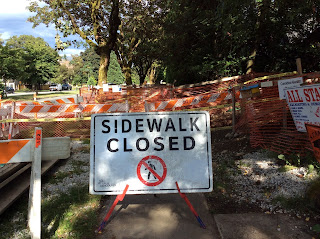
Pedestrians have to take their chances in the face of  Vancouver's real estate frenzy. This sidewalk closure, in conjunction with a new house under construction, was in Point Grey.

Construction equipment is becoming as familiar as cars on Vancouver streets. 

As I listened to the familiar crunch and punch of a bulldozer tearing apart yet another house in my Dunbar neighbourhood this week, I thought about the $3-million-plus somebody had paid for the right to do that. And the cost of rebuilding. And whether the resulting shiny new mansion will sit empty for years, like many in my area.

I was also thinking about how for years, anyone who suggested offshore money has anything to do with sky-high real estate prices, demolitions or vacant houses in Vancouver has been accused of racism. Indeed, that was Mayor Gregor Robertson's reaction last fall when urban planning researcher Andy Yan found 66 per cent of buyers in Vancouver's most expensive neighbourhoods had non-anglicized Chinese names, which he said implies they're new arrivals. The mayor's response? "This can't be about race, it can't be about dividing people."

The politicians and the real estate industry -- both with a lot to gain from keeping the real estate ball rolling -- had their way for many years. People were scared of talking about offshore money. A July 7 Guardian story posits this is partly because of Vancouverites' uneasiness about anti-Chinese events here in the early 1900s. "Vancouver was the stage for some of Canada's ugliest episodes of racism: anti-Chinese riots, a 'head tax' on ethnic Chinese, and later an outright ban on Chinese immigration."

But as activist Justin Fung told the Guardian, the housing crisis is a policy and social justice issue. "If you can't even talk about where the money is coming from, you can't do anything about it."

And you have to ignore facts like this:

- Vancouverites have the lowest incomes out of 10 major metropolitan areas in Canada, but the highest home prices. ("The Departed," Vancouver magazine, June, 2016)

- Young people are leaving Vancouver. There was a net loss of 2,350 people aged 25 to 34 to other provinces between 2011 and 2015. That compares to a net gain of 4,199 such people from other provinces in the years 2006 to 2010. (Vancouver magazine, June issue.)

- The price of a typical detached home in Metro Vancouver rose 37 per cent in the past year, to $1.5 million as of May 2016, according to the Real Estate Board of Greater Vancouver.

In response to that last fact, the mayor finally admitted in June that offshore money is an issue. "With unregulated, speculative global capital flowing into Metro Vancouver's real estate, we are seeing housing prices completely disconnected from local incomes."

Even B.C. Finance Minister Mike de Jong has finally acknowledged that the impact of foreign money on the real estate market is "real." "There's certainly a presence," he said last week. "It is actual, it is factual, and it is beyond conjecture."

But in the last few days, there have been a couple of articles reviving the notion that any criticism of the goings-on in Vancouver's real estate world amounts to racism. Under the headline: "Racism now up front in the housing debate," in Saturday's Vancouver Sun, columnist Pete McMartin said the issue is no longer about housing, but "a matter of culture and race in an increasing climate of mutual resentment."

And in the traditionally left-wing Georgia Straight, Charlie Smith offers obscure praise to longtime journalists who apparently learned their lesson about racism during the controversial flood of Hong Kong residents into Vancouver in the 1990s, and are now reining themselves in in discussing the current problems.

On the ground, in the heavily targeted Dunbar, Point Grey and Kerrisdale neighbourhoods where I walk, I see the real-estate tornado first-hand. Some blocks have been turned upside down by the frenzy; it's actually a surprise to see a house with people living in it, without a for-sale sign or white border markers indicating it's been surveyed for sale. What comes to seem normal are the old houses, vacant and weed-grown, awaiting demolition; houses in various phases of being torn down or rebuilt; or spanking new houses that are glaringly vacant.

I don't think it's racist to worry about your neighbourhood turning into a lonely wasteland. Or as Robertson has finally said: "First and foremost, housing needs to be for homes, not just treated as a commodity."

"What you have is a huge pool of very wealthy people who want to hedge against uncertainty back home," says Thomas Davidoff, a real estate economist at the University of B.C. "Combine anxious money -- a lot of it -- with a beautiful gateway city that has limited space to build, low property taxes, lax regulation on capital flows, and wealth-friendly immigration programmes, and you get a market like this one." (Guardian, July 7, "Race and real estate: how hot Chinese money is making Vancouver unlivable.")

https://www.theguardian.com/cities/2016/jul/07/vancouver-chinese-city-racism-meets-real-estate-british-columbia?CMP=share_btn_link

Green walls

Vancouver's huge hedges lend themselves to odd shapes and uses. During my walks around the city, I began noticing the ways people have exploited their green walls to turn them into something useful, mysterious or playful. Here are some examples:

What a stately entrance to this garden! Two pillars and a wrought iron arch overhead keep the hedge opening neat and elegant.

One big hedge running the length of two properties required the cutting of  a "door" for each. I loved the sense of connection and separation this gave. 

This was a smaller hedge I had passed  many times, but one day I noticed an arch had been cut to showcase a little statue of a nude. 

A big old laurel hedge can be made into almost anything. Why not an arch to mark the entrance to the property?

My friend Linda poses under a cedar arch during our walk on Saturday.

Sunday, July 10, 2016

Sharing beauty

An English cottage-style garden  at Third and Collingwood in Vancouver is my favourite in the whole city. On Saturday, my friend Linda checked out the wide variety of blossoms  -- red hollyhocks above, yellow corydalis below, and blue hydrangeas in the middle.

Lush plantings tumble around the white picket fence, a contrast to the smooth green patch of lawn.

Each section of the garden blends with the others, but provides its own blast of colour.

Unusual yellow lavatera in the back contrasts with the red hollyhocks in the foreground.

Lavender and campanula form a purple-blue base for the picket fence. The grey-leafed tree to the left above is an ornamental weeping pear. In the background, you can see the property's grey Craftsman house.

This is what the garden looked like in May, with orange Oriental poppies in bloom.

Another photo from May, when the roses were in bloom in the garden. A hot dry spring brought all the flowers on earlier than usual. 

Twenty-three blocks straight down the hill from me is the best private garden in Vancouver. Or at least the best in my little orbit of the city. A corner lot at Third and Collingwood, it is beautiful in all seasons. In spring it bursts with bulbs and blossoming shrubs; in summer it is lush with lavender, lavatera, roses, buddleia and other mid-season blooms; in the fall, it puts on another show of bright late-season flowers. It is quiet in winter, but always beautifully maintained.

One mystery about this garden is the gardeners themselves. In all the years I have walked past this Kitsilano showpiece, I have never seen anyone actually working in it, yet it is always so perfectly maintained that somebody obviously works there a lot. Perhaps the gardeners are early risers; as a late riser myself, it is possible our paths have never crossed. There has certainly never been any hint of a commercial gardening service being involved. I like to think that everything is done by gifted amateurs who carefully plan out every season in every corner of their garden from behind the stained glass windows of the pretty Craftsman house on the lot.

But the best thing about this garden -- besides its plants -- is its generosity. A more miserly owner could have kept all this beauty private, hidden behind high walls or hedges. But instead, someone has chosen to freely contribute all this abundant, tumbling glory to the community -- surely an example to us all.

At the junction of Collingwood Street, you'll find an impressive English cottage-like garden where a carefree mix of hollyhocks, phlox, lacecap hydrangeas and buddleia mingle behind a white picket fence, lavishly skirted by lavender, campanula and yellow corydalis. The whole street is really one lovely garden after another, as if all the neighbours had gotten together and agreed to create an avenue of flowers and foliage for all to enjoy. -- Vancouver Sun gardening columnist Steve Whysall, July 7, 2016 (In the garden: Vancouver's great 'green' streets)

Friday, July 8, 2016

Vancouver's little gulag

The former Olympic Village (now called Millennium Water) is a grey place indeed, but my friend Ros enjoyed the giant sparrow statues.

This is an example of what the village looks like in summer. Take away the greenery, and imagine how bleak it looks in the winter. My partner John calls it a gulag.

Construction around the village continues apace. There are never enough luxury condos in Vancouver.

En route to the village, Ros and I stopped to sit on the chairs locked together on the seawall. Ros took this picture of me looking out over False Creek.

Outside the village centre,  flourishing garden boxes provide a jolt of colour and some fine vegetables.

My friend Ros has been away from Vancouver long enough to have missed the whole Olympic Village fiasco -- its initial developer going into receivership, the city having to take it over to get it done in time for the 2010 Olympics, the controversy over whether the city actually lost money on the deal, the village's years as a ghost town, and the complaints about shoddy construction, complete with photos of water running out of electrical outlets.

As a Vancouver Sun editor, I had dealt with many of these issues as they arose, but I'd never spent much time in the village itself. So when I suggested to Ros that we make the former athletes' village our destination for a walk Friday, both of us were heading into unfamiliar territory.

"A village?" she said, when I first pointed it out in the distance. "It doesn't look like a village. It looks like a whole bunch of highrises."

As we continued along the seawall toward our destination, she noticed the grasses and trees of Habitat Island in False Creek, a man-made peninsula aimed at replicating a natural shoreline habitat. "It looks," she said, "like it's trying to escape the village."

The village didn't impress on first inspection, with its minimal greenery, swaths of concrete underfoot, and its rows upon rows of massive blocky buildings. I told Ros that my partner John, who has done some photography there, calls it a gulag, especially in winter when it loses its greenery. Ros thought gulag was a good word for it.

There were some positives. Village tenant Terra Breads makes great chocolate cookies, one of which we shared on a bench looking out over the water. The canoe bridge was a hit, although Ros noticed the sad green mould on its white superstructure. People were sitting and chatting on stacked grey blocks stepping down to a water feature, which we agreed was kind of village-like. And Ros liked Myfanwy MacLeod's giant sparrow statues.

I learned later that MacLeod was inspired by Alfred Hitchcock's creepy The Birds in creating them. She used sparrows because they are a foreign species introduced to North America, which then wiped out many native birds. She saw the giant statues of the little birds as beautiful but frightening, a warning of how a foreign species can upset the ecosystem, as well as a message that we should pay attention to the interdependence of nature. Hmmm. Anything like tons of grey concrete wiping out all vestiges of nature on the land the village sits on?

I also learned that because of the high LEEDS building standard the village attained, it is considered one of the world's greenest neighbourhoods. It is the greyest greenest development I have ever seen.