Monday, August 15, 2016

The sun sinks slowly...

The sunset through a ferry window on Friday, as photographed by John. I am there to add perspective.
 When the sky flamed a spectacular purple and orange through the ferry windows on our way home from Saltspring Island on Friday, John couldn't help himself. "As the sun sinks slowly in the west, we bid a reluctant farewell to the friendly natives of...," he intoned, imitating the famous endings of the old travel shorts shown in movie theatres.

Vacations on Saltspring always have their ups and downs, but like James A. FitzPatrick, who began producing those Traveltalk films about exotic locales in 1929, I will mention only the positives. (FitzPatrick, a former children's teacher, was criticized for never reporting on ugliness or even minor annoyances in his films, but maintained that showing young people the bright side of life would put them on the track to more constructive thinking.)

So, my positives from Saltspring, this time around: Surrendering to the first chill of an ocean swim, then finding it glorious on a hot day. Conversations with members of the Vesuvius Beach Indolent Society, the wide variety of Saltspringers who congregate on the beach about 4 p.m. every swimming day. Setting up colourful chairs and a table on our deck, and seeing the view through a pretty bouquet. Watching the red geraniums I planted on the second day of our visit flourish. Some good walks and photo-taking excursions in the Vesuvius area. Watching the Perseid meteor shower in the dark of our back yard on a hot summer night, and hearing the exclamations of our invisible neighbours doing the same thing. A trip home on a small ferry where the workers and passengers formed a friendly little community as we plowed through Active Pass in the dark. And finally, the sunset that prompted me to find out who the heck began that "sun sinks slowly in the west" business anyway.

Flowers on a table on our deck add colour to the background scenery.

Mr. Darcy and the red geraniums.
 
These are the boats we see every day when we swim at Vesuvius Beach.

Vesuvius Beach, supposedly the warmest on the island. People from all over the island come here to swim, and in the evening, often bring a picnic supper.

The chairs of the Vesuvius Beach Indolent Society, occupied from 4 p.m. to 6 p.m. on hot days in summer. You sit on a chair or on the log and talk. When you're hot, you go for a swim. Repeat. 

Seaweed, or "vegetable salad" on the beach. Some days, the water is soupy with seaweed, and sometimes there are jellyfish. On the best days, the water is warm and clear.

A pretty little gate on one of the properties bordering Vesuvius Beach. 

One of the scenes I photographed during walks in the Vesuvius area. This is an arbutus tree by some stairs leading down to Booth Bay.

Thursday, August 11, 2016

A world of differences

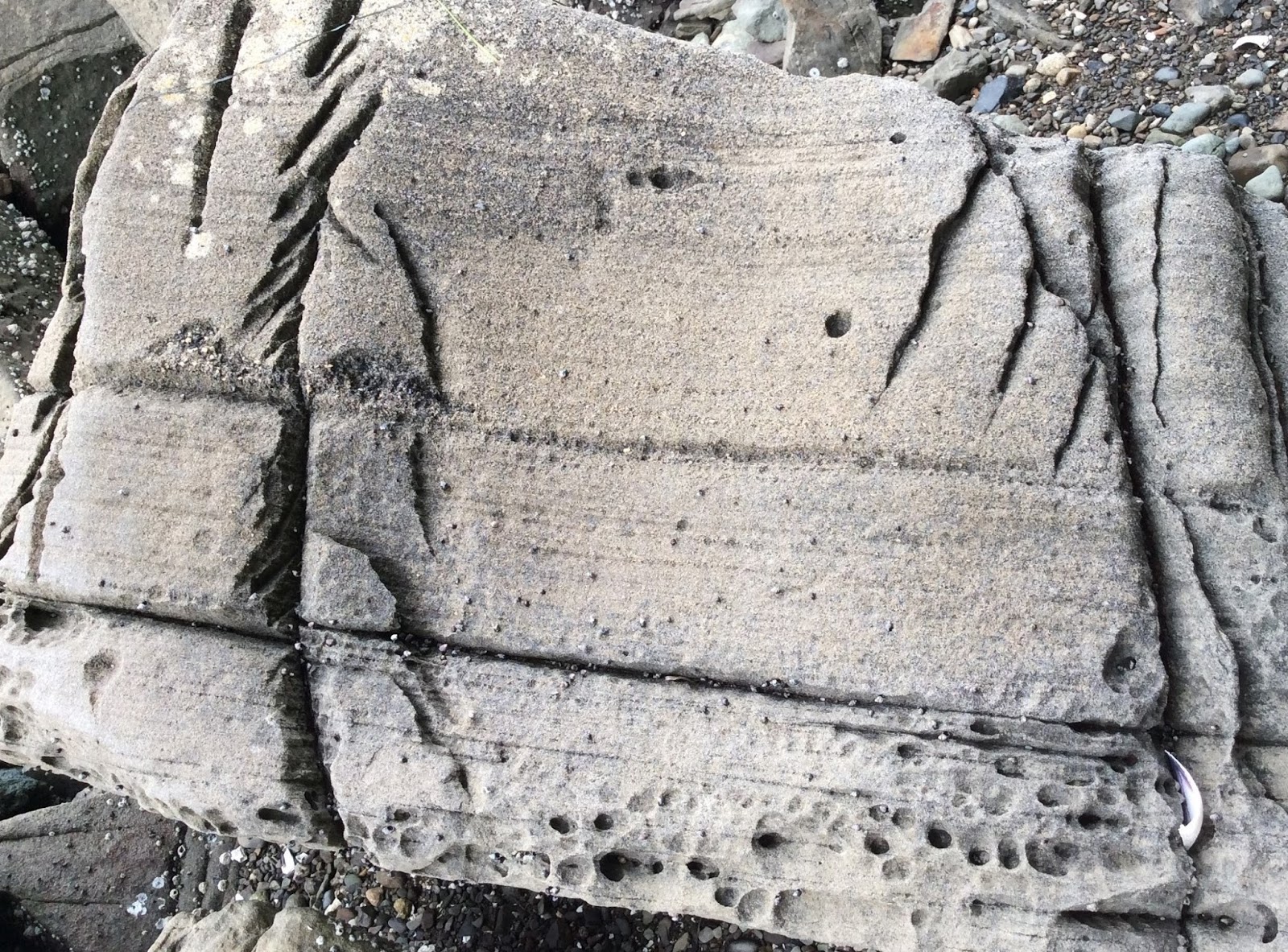
Low tide at the Booth Bay tidal flats on Saltspring Island reveals a stunning variety of rocks.

This rock, reminiscent of an ancient carving, prompted me to start looking around at what else was on the beach.

It was a rock that looked like a disintegrating Greek carving that opened my eyes to what else lay beneath my feet on a stretch of Saltspring Island beach this week. It's a special beach, open to both the rough waters of Samsun Narrows and to the gentle forces of the Booth Bay tidal flat, which at high tide resembles the ocean and at low tide turns into meandering streams too shallow for tiny rowboats.

I don't know whether it is this combination of ocean forces that is responsible, but what's left on the beach is remarkable: All shapes and colours of rocks, carved by nature into an art museum's worth of patterns and designs. 

 Some have horizontal and vertical lines so straight they could have been traced by a ruler; some are as curvy as the rivulets of water that must ride over them. There are pincushion rocks riddled with tiny deep holes, and rocks with depressions so deep you could put your fist in. There are rocks divided geometrically into inch-square segments that could be an intricate piece of kitchen tiling. There are rocks with overlays of filmy tracery, like lace over a fancy dress. There are rocks that look like a master carver had a go at them centuries ago, before time smoothed the sharp edges. Most of the rocks are shades of grey, but then, suddenly, a blue rock, a red rock, a white one, and rocks the colour of sand.

It's the differences that make this rock-collection discovery so delightful. A reminder of the value of all of our variety, and how we need not just straight-line geometric patterns, but curvy lines and ripples, and even filmy lace to make the world go 'round.

Straight lines, fissures and a few round holes create a fine pattern.

By contrast, hardly a straight line in the bunch. This could be a cracked windshield or an ancient face. 

The top of this rock was all curves and ripples, as if the wavelets running over it had inscribed themselves in the stone.

In the middle of grey tones, suddenly, a blue rock.

A red rock and a bluish-white one sit near each other.

A rock the colour of sand, with graceful swirling lines inscribed in it.

This was a white rock with a blob of  blue, and a pattern of delicately traced holes being carved out of the stone.

This was my favourite of all the rocks. It looked like a layer of lace had been delicately sculpted over the underlying stone. 

A "pincushion" rock, a multitude of tiny holes.

By contrast, this rock had holes big enough to collect seaweed and other detritus in.

This is part of the cliff face along the beach. It consists of  a multitude of tiny squares, broken off along the top edge.

A close-up of the tile-like rockface, divided into inch-square segments. 

The top of this rock was eaten away into sculptured holes; the bottom was still intact.

A typical fine big rock on the beach.

The top of this rock had been eaten away to create a hat-like effect. 

An example of the geometric squares typical of many of the rocks on this beach. 

This is how low the tide gets along the Booth Bay tidal flat beach. There are many beautiful homes along the bay.

The beach where all the rocks are formed. You never know what might be under your feet!

Tuesday, August 9, 2016

Saturday market

I don't usually shop at Saltspring Island's Saturday market, but made an exception this time around. Here are the treasures I brought home. More photos of the market below.
It might sound churlish, but I'm not usually a fan of Saltspring's Saturday market. The jostling, the crowds, the pricey products. But the weekly event is a feast for the eyes, especially the rainbow of fruit, vegetable and flower stalls, so John and I tend to tour the aisles on market days just to enjoy the sights.

Another plus is the high probability of running into island acquaintances we haven't seen for awhile. Because, for all their complaining about the crowding, traffic and parking, islanders do patronize the market for specific items available only there. Mostly, this is bread, brought in every Saturday by a few of the island's talented home bakers. They sell out so fast that islanders strategize carefully to ensure they get their weekly fix -- one couple told us they know to the minute when they have to leave their front door to ensure they get to the bread lady's stall in time.

Last Saturday I decided to take advantage of the market's specialties for a dinner I was hostessing that night. For all the crowds and jostling, it was a treat to ponder the wide selection of homegrown bouquets at the flower stall, to meet the growers of a small box of perfect strawberries, and to realize I'd reached the bread lady's stand in time to get what I wanted. It was there that John got caught up in talking to some of those chance-met islanders, so I bought two loaves on my own and continued with my shopping. When he caught up with me later, he was triumphantly brandishing his prize -- another loaf of bread!

So, a visit with friends. A box of perfect strawberries that made my dessert sing. A bouquet of flowers that will brighten our house until the end of our stay. And two extra loaves of delicious bread in the freezer. Who could be curmudgeonly about a market like that?


Islanders plot their Saturdays carefully to make sure they get to the bread lady's stand in time for her famous loaves.

Several stands offer sweeter treats.

Island farmers count on the market to sell many of their products.

Fall flowers are taking over at the flower stall. Notice the sunflowers and dahlias. 

Fruits and vegetables add colour and beauty to the market's aisles.

More of the sweet-makers' treats.

Somebody has figured out that a cut piece of carrot cake with a fork jammed in the top will sell a lot faster than a big cake that needs to be cut and utensils found.

This display of pastel pottery was too pretty not to photograph.

My autumn bouquet from the market. It will brighten our house until the end  of our Saltspring stay.


Monday, August 8, 2016

The hot house

Ever since we bought our Saltspring Island house, a favourite exercise has been to think up ways of  keeping it cool in the hottest days of summer.

Plunk an uninsulated, flat-roofed, many-windowed house on a bare hillside in the hottest part of a Mediterranean-climate island, and imagine what it's like inside when summer temperatures soar!

In the first flush of post-purchase enthusiasm 16 years ago, we toyed with some serious solutions -- proper insulation, a new roof, new double or triple-paned windows, a second storey, a complete rebuild.

But all these projects cost a bomb, and we're not here that much. So for a decade, conjuring up imaginative ways to cool the house down in the summer has been a favourite parlour game -- visitors are welcome to join in! Exterior tarps over the windows? A roof over the huge deck that bakes uselessly in the sun all day? Big umbrellas? Skylights to let the heat out? A second deck out back, where there is already some shade? An air conditioner? A shelter over part of the deck?

We've tried or seriously considered most of the above, but discarded them because they were too expensive, blocked the view or would have changed the feel of the house too much. But this year, we had a go at the last two.

Enter the little mobile air conditioner that would cool at least one room when the heat got unbearable. The salesman thought so much of it that he gave John $50 off the price "because they usually only last a season anyway." So far, we've used it for about six hours. The first time, it made the lights in the house flicker. The second time, it made the lights go out altogether and blew a fuse. The third time, when John put it on a circuit that had nothing else on it, it still made the lights flicker. Hmm... maybe it's not so hot after all.

The little air conditioner that blew our lights out.
The second experiment was to erect a shelter over the end of the deck to give a little spot of shade without blocking the interior view. Working in blasting heat, John put up two support beams and draped an experimental tarp over them. The result: A tiny moving square of shade, barely enough for one person to sit in, in the midst of blistering heat.

Both of this summer's experiments have now been jettisoned. August is proceeding, temperatures are dropping, the house is quite comfortable. Next year we will probably have some more ideas.

John works on one of this summer's bright ideas -- a shelter over the end of the deck. Notice the protective headgear.

Lots of work for not much shade -- and it's blazing hot anyway.

John dismantling the deck shelter. 

All back to normal. At the end of his efforts, John turns to the only tried and true cooling-off strategy we have found-- walking down the hill and plunging into the ocean.

Here's the reason we have so much trouble actually doing anything: We like the unimpeded view out of the window. A deck covering would ruin that. 

Thursday, August 4, 2016

A Saltspring solution

When this is your backyard and you have a fully outfitted sailboat anchored in it, what are you going to do when your summer visitors have filled up all the beds in your house?


After a day of storm clouds and a spatter of rain, we could just see silvery grey water shining through the trees as we walked the 30-some steps down to Vesuvius beach at sunset Tuesday. A tangle of branches and blackberry vines hides the vista until you nearly reach the bottom of the stairs, but when we got there, it was like walking into a watercolour painting. All soft blues and greys; the only brightness was the pulp-mill plumes across the way transformed by the sun into spires of light.

The melancholy day had sent the beach into near-winter seclusion; the usual crowd of sunset-watching summer visitors had vanished. But there, nearly at our feet at the bottom of the stairs, were two of our Vesuvius neighbours, packing something into a little rubber dinghy. Against the evening chill, Suzanne was wearing a red coat; Keith a long-sleeved shirt.

"We have a house full of guests," Suzanne laughed by way of explanation. "All the beds are full." And so they had packed some overnight gear and were rowing out into the twilight. A few hundred yards away, the comfy overflow beds of their fully outfitted sailboat awaited them in the pastel watercolour that was Vesuvius bay.

Suzanne and Keith prepare to take off in their rubber dinghy.

Off into the sunset, Keith at the oars. Photo by John.


The pulp-mill plumes in the background, Suzanne and Keith head out for a night on their sailboat.

Tuesday, August 2, 2016

Out of the past

John's photograph captures Mr. Darcy coming face to face with a coal-oil lamp from the Alberta farmhouse where I grew up.


Reading a novel from the 1840s by the light of a coal-oil lamp seems very appropriate. John lit the lamp and brought it out to where I was reading on the deck of our house on Saltspring Island. 

As mom and dad gradually got rid of their possessions during their many moves after they left the farm, they distributed mementos of that long-gone world to each of their five children. Among the things that came to me was one of the coal-oil lamps that helped light our farmhouse until we got electricity there when I was about 13.

In the pre-electric days, the "serious" light was from kerosene lamps, with their peculiar smell and mantles so delicate they'd disintegrate at a touch. Kerosene was for the kitchen and living room, but in the bedrooms, there were dimmer coal-oil lamps.

We usually did our homework in the brighter-lit areas, but at some point I likely read or studied by the very same coal-oil lamp that now sits on our mantlepiece on Saltspring Island. On Monday night, John lit the lamp "just to see if it still works" and brought it out to where I was reading on the deck. It gave a pleasing warm yellow light, quite sufficient to read by, and nicely in tune with the book I was reading -- Charlotte Bronte's Shirley, written in the 1840s.

I don't know the provenance of the lamp, but since it was around when I was a child, it is at least 66 years old, more likely 70 or more. It may have even belonged to Grandpa Volkart, as my parents moved into his house when us kids were young, in which case it could be much older.

When John tried it out Monday, it lit at a touch, and worked like it always had. Which made me think about technology and planned obsolescence. I wonder how much of what is being manufactured today will still be working -- and pleasing -- 70 years from now?