Sunday, November 14, 2021

A new definition of wet


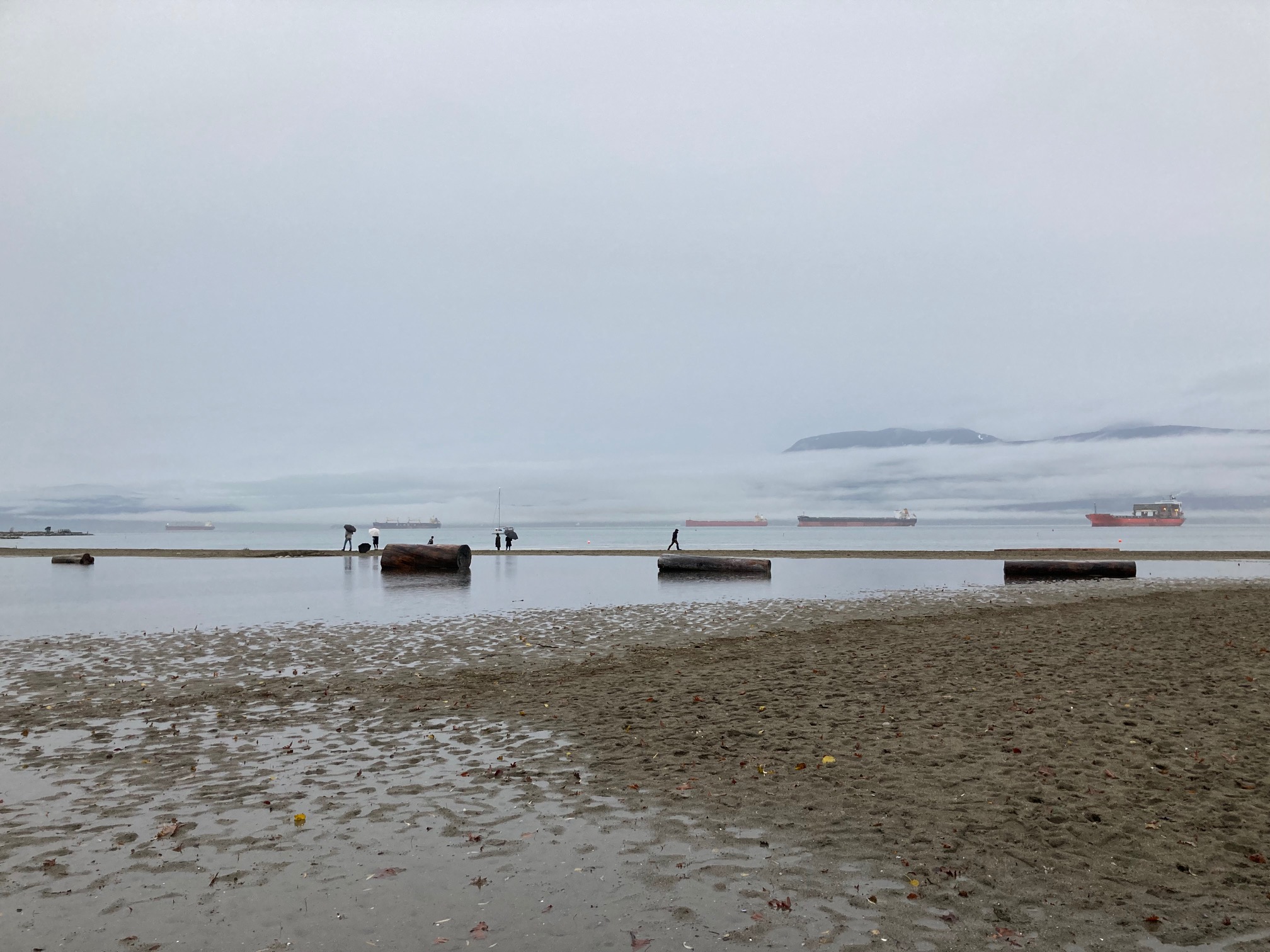
Grassy fields turned into lakes at Jericho Park on Sunday afternoon, thanks to about 150 mm of rain. Climatologists said we've just experienced an "atmospheric river." 

A few years ago, I’d never heard of polar vortexes, heat domes or atmospheric rivers. We just said it was bloody cold, scorching hot, or raining a monsoon out there.

But now that we’ve all tapped into climatologist-speak, I can report that “atmospheric river” is a good description of what walking on Jericho Beach felt like on Sunday afternoon. With rain falling from above, pooling at my feet, and moisturizing me under my umbrella, it was, yes, a little like swimming through water-saturated air.

The U.S. National Oceanic and Atmospheric Administration describes atmospheric rivers as “rivers in the sky.” They are long, narrow regions in the atmosphere that carry an amount of water vapour “roughly equivalent to the average flow of water at the mouth of the Mississippi River,” according to the administration website.

When this vapour makes landfall, you get this weekend’s Jericho Beach – a transformed topography of islands, streams, lakes and peninsulas, a puzzle for rain-suited dogs and humans alike. A place where runners stop suddenly at the sight of ducks and geese swimming over their usual running paths. A place where the ocean creeps up the sand, past the summer lounging logs, as if eager to join the newly created lakes and streams.

In the past, we’d just say we’d had one heck of a wet weekend. But if we've really been walking through the equivalent of the average flow of the Mississippi River, maybe a little hyperbole is justified.


Where does the ocean end and the newly created lakes begin? Water has crept up past the beach logs, but beyond them, people are walking out on a sandbar. In the distance, there are the freighters and cloud-socked-in mountains.  

Sandbags like these around the entrance to a washroom are piled up in many places to keep the water out.

Here's a main walking/running path that ends in a lake. Ducks and geese are enjoying it.

Everywhere, new ponds have appeared wherever there are depressions in the ground. 

Walkers stand and stare at the new terrain. The dog carries on as usual. 

This little picnic table sits in its own private pond. 

Another view of the water-dotted, water-logged landscape. 

The ocean again, with the logs and the walkers. 

In another section of the park, there have always been ponds, but they're bigger and fuller now. 

Sunday, October 31, 2021

Halloween, again


A ghost, a chandelier, and a creepy watching figure in the crook of the tree show Halloween is still alive and well in this household.

Go big or not at all seems to be the attitude toward Halloween this year, our second go-round with this festivity during the never-ending pandemic.

Last year, the media was full of stories about safe ways to give out treats – dangle them on sticks from the top of your stairs; shoot them down toward the kiddies through a pipe attached to your stair banister. Noticeably fewer houses were decked out for Halloween 2020; after years of mounting enthusiasm, the celebration was flattened by Covid.

This year, it seems many householders have bowed out of the Halloween business altogether. During a walk today, I saw whole blocks without even a doorstep pumpkin. But in some areas – probably those with more kids – decorations were more lavish than ever. Ghosts and skeletons were ubiquitous, but there were also gyrating mechanical monsters, fake fog, firepits ablaze, creepy noises and cackling voices, and a whole family of scary creatures gathered in one front yard.

Even before the sun went down, I spotted a fully made-up witch walking her dog, twin toddlers in matching full-skirted purple dresses and witches’ hats, and groups of costumed parents and children gathering around outdoor treat stands. Halloween may have suffered a crisis, but I suspect it is not dead yet.


Along with the elaborate decorations I noticed this year, there were also very simple ones. A string of pumpkin lights in this shrub will turn it into something interesting in the dark.

Ghosts hanging in a garage door are another simple way of declaring Halloween.

Another view of the earlier ghost dangling over the sidewalk, with a dark-shrouded figure of who knows what providing a counterpoint. 

A crowded front yard of Halloween figures prove that more is more when it comes to celebrating this holiday.

The family, gathered to await the evening's trick or treaters. 

Monday, October 11, 2021

Thanksgiving 2021

Covid is keeping us from celebrating Thanksgiving over a dinner table, but my sister Betty and I can still walk in the woods. Here we are in North Vancouver during a late-afternoon family walk. Photo by John Denniston. 

During our walk, we came across an outdoor pen of guinea pigs, much to the delight of Betty's one-year-old grand-daughter Mia. A handful of dandelion leaves was worth a half-hour of enjoyment. Photo by John Denniston. 

A ferry ride away, my brother Brian was enjoying the sunshine on our Saltspring Island deck. 

 “Together apart” has been the Covid-19 motto for the past 18 months, and for us, it fit this year’s Thanksgiving perfectly.

My sister Betty and her husband Bert were in town from Quebec, helping their son and daughter-in-law transition their two kids into school and daycare. My brother Brian and his wife Wendy were driving through from Alberta, on their way to spending some time on Vancouver Island.

But did we gather the clan and have a big sit-down Thanksgiving dinner with the reunited siblings and Betty’s son and family? We did not.

Medical issues mean we’ve had to stay strict about Covid protocols, so our sibling reunion was masked and brief, one evening at an AirBnB. Then Brian and Wendy headed off to Saltspring to spend Thanksgiving at our cottage.  Betty and Bert and their son’s family had Thanksgiving dinner together; instead of joining them, John and I dropped by later for an afternoon walk.

But this happened too: Wendy sent us greetings and a photo of Brian enjoying the  sunshine on our island deck. John and I got to walk in the woods with Betty and Bert and catch up with their son Etienne and his wife Aya. We caught our first glimpse of six-year-old Emi and one-year-old Mia being sisters together. During our walk, we met a friendly cat and guinea pigs in an outdoor pen who needed to be fed dandelion leaves. And when we left, Aya handed us containers filled with the turkey dinners we hadn’t been able to share with the family.

Together apart indeed.


My niece Aya shared the bounty of her Thanksgiving table with these very generous take-home portions. We'll be celebrating Thanksgiving for a few days to come!

Saturday, October 2, 2021

Family visits

This is how we visit now: Outdoors and safely apart,  we had coffee with my brother-in-law Bert and my sister Betty three weeks after they arrived in Vancouver from Quebec. Betty is showing a photo of her one-year-old granddaughter Mia, whom they met for the first time when they landed. Mia immediately decided Bert was "the one," but has now accepted grandma too. Photo by John Denniston.

 Once upon a time, visits from far-off relatives meant a cooking/cleaning frenzy. You wanted to feed them something special, and you didn’t want them noticing the grime in the bathtub.

During COVID, it means calculating risks. Who have they seen? How have they travelled? Have they been here long enough to be decontaminated? Do we dare a visit indoors? Wear masks? Hug?  

It doesn’t seem very welcoming, but it makes life easier. Forget the fancy dishes – a lengthy indoor meal is an unthinkable luxury. And guests’ brief darts into your bathroom require only a surface shine.

My sister Betty and her husband Bert have been visiting from Quebec since Sept. 7, helping their son and daughter-in-law transition their young children into school and childcare. Due to colds and concern over their potential exposure, we didn’t see them until Oct. 1. We did air hugs, then sat in the sunshine in their son’s North Vancouver garden. Face to face, the lack of frills, fuss and frenzy didn’t matter. It was enough.  


Saturday, August 7, 2021

Kayaks, paddleboarding and the art of the possible


Circle Saltspring Island by kayak and paddleboard in one day? No problem, according to this trio, who did the 71-km journey in about 12 and a half hours on Aug. 5. Left to right are Andre Gerard, Alison Wood and Margo Lillie, shown as they head past Ruckle Park. All photos by John Denniston, who tracked them around the island for the day. 

“Can’t be done,” the man on the beach said when we told him our friends were planning to kayak around Saltspring Island in one day. A fit-looking middle-ager, he was visiting his mom on the island for a few days. He and his wife, younger and also fit, are enthusiastic cyclists, but were entertaining themselves with some kayaking during their visit. Exhausting, slow and hot, they concluded after a particularly strenuous 20-kilometre session. It would be impossible to do the whole 71-kilometre trip in a day, the man said, “but I wish them luck.”

He hadn’t, of course, met Andre Gerard, 68, his wife Margo Lillie, 67, and their friend Alison Wood, 52. Before Andre and Margo moved permanently to Saltspring Island from Vancouver a year ago, they regularly began their days either climbing the North Shore’s arduous Grouse Grind or kayaking out of Jericho Beach. They’ve always hiked, the steeper and longer the better, although knee issues have temporarily slowed Margo down.

Their friend Alison, who with her husband operates the Mount Seymour Ski Resort in North Vancouver, is a former competitive sailor and triathlete whose paddleboarding skills have taken her to a world championship in Fiji. She’s also co-founder of Ocean Ambassadors Canada, which teaches kids about plastic pollution and paddleboarding.

Besides higher levels of fitness than most people half their age, the trio had a secret weapon. Margo (aka Dr. Lillie, a long-time whale researcher at the University of B.C.) used her research skills to pinpoint the day, the winds and the tides most likely to ensure the venture’s success.

The gods cooperated. Aug. 5 dawned pink and calm with a slight cloud cover, and the water was glass-smooth as the three set out from Bader’s Beach  shortly after 6 a.m. Twelve hours and 38 minutes later, including about an hour’s worth of breaks, they arrived back at their starting point.

They slipped in quietly, almost unnoticed by the supper-and-sunset beach crowd. But when someone asked where they’d left from, and the response was: “Right here, about 12 hours ago,” there was  astonishment.  “That's impossible!” one young woman said.

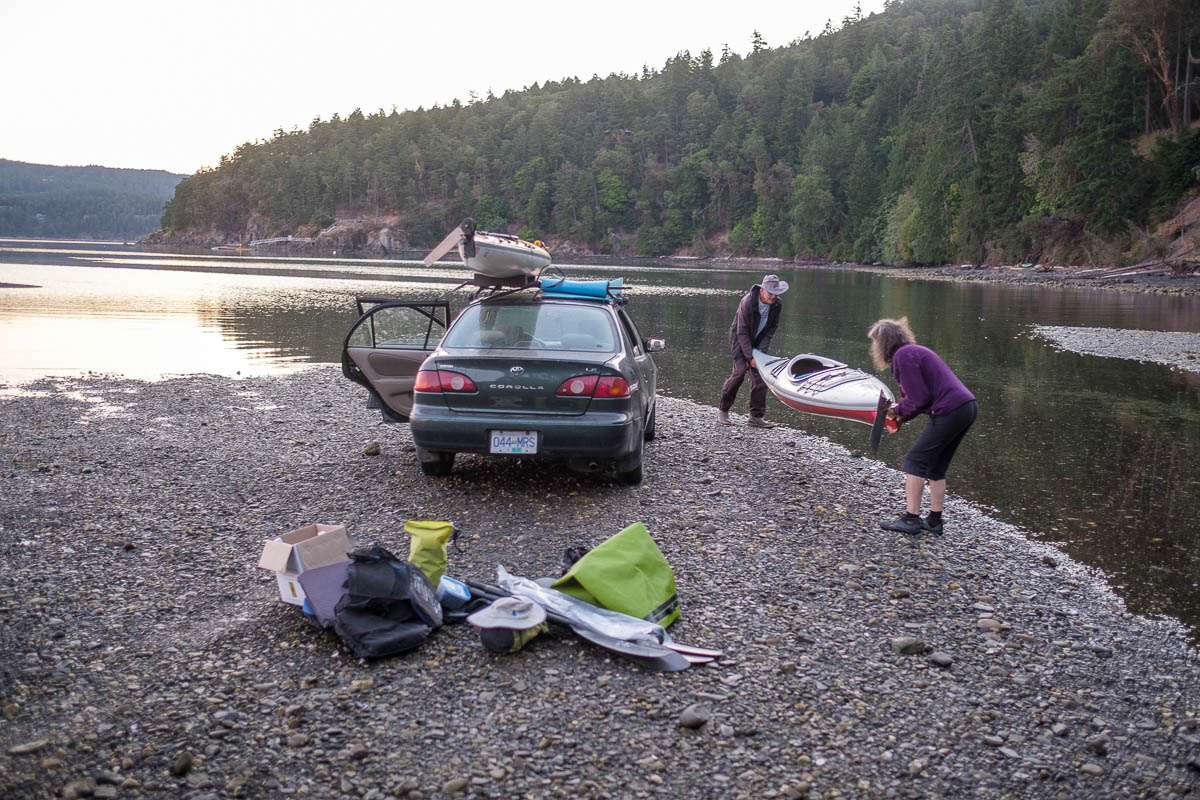
Kayaks above their heads, Margo and Andre arrive at Bader's Beach to begin their adventure. Their starting point was about halfway down the west side of Saltspring Island, and they travelled south from there. 

One advantage of the beach for boaters is being able to drive out at low tide to make launching easier. 

Andre and Margo unload the kayaks. Food, water and other gear  waits in the foreground.
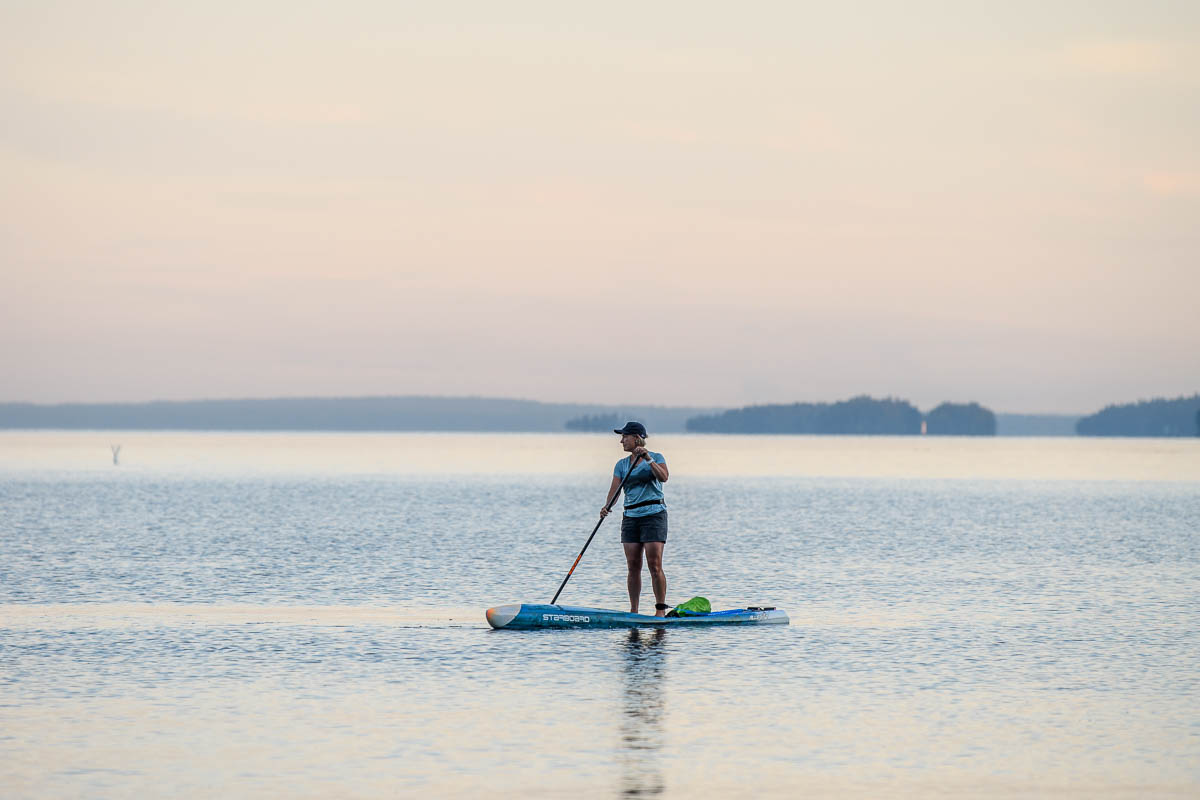
Perfectly balanced, barefoot and carrying her own supplies, Alison brings her surfboard to the launching spot.

While the kayaks make their first contact with the water. . .

Alison is already aboard and paddling.

A salute to the shore-watchers as the adventurers take off  shortly after 6 a.m. In the distance is the Crofton pulp mill on Vancouver Island. 

The rising sun casts a warm glow on the shore behind the trio as they begin the first leg of the journey.

Andre leads the way into Beddis Beach for a picnic at about 1 p.m. At this point, the group has done the south part of the island and is heading back up north. They took four breaks, totalling about an hour.

By the time they reach Fernwood at about 4 p.m., heading for the island's northern tip, they're ready for a diversion and a cooling-off. With effort, Andre tips the very-balanced Alison into the water.

The game then is to splash Andre with enough water to ensure he's equally soaked. 

By about 6 p.m. -- 12 hours after they began -- the three show up at Vesuvius on the island's west side. 

John and I had to drive fast to get from Vesuvius to Bader's Beach to watch them come in just before 7 p.m. Here they are, with the Vesuvius ferry to Crofton in the distance. 

 The three slip into Bader's Beach almost unnoticed by the party-goers around them. 

Home again! Now it's just a matter of loading up all that equipment.

But first, some bubbly. I join the athletic threesome while Andre gets the cork to pop out.  

Andre pours ...

...and, a toast to a successful day. Who said it couldn't be done?


The 71.05-km route around the island, all carefully laid out in advance.

Wednesday, July 28, 2021

The sweet, the blighted and the fleeing

Gardening is an ever-learning experience. This year's crop of sweet peas taught me they grow much better if you give them space and sunshine....

...instead of planting them in the midst of a forest of delphiniums, which had given me sad results indeed for the past two years.


I also learned that my garden is not meant to grow strawberries. Here, I'm holding up pretty much the entire crop. Photo by John Denniston.


When we got back from Saltspring last weekend, the sweet peas had taken over one end of the garden bed -- a pastel tangle of sweet-scented pink, white and purple reaching for the sky.  It was a victory of sorts, because I’d feared I’d lost my touch. After two years of trying to coax sweet peas to thrive in the midst of towering delphiniums, this spring, I finally admitted defeat and moved them. Space, sunshine and a bit of fertilizer later, I once again have sweet peas scenting the house.

Gardening is a constant battle with the elements, though, and the strawberries I planted in the food-growing frenzy of our first Covid spring are another story. The first year, I obediently nipped off the flowers to help the plants get established, expecting a big payoff this year. It never came.

 The berries were few and far between, and once they got to a certain stage, as if deciding the whole exercise was pointless, they turned to mush and shrivelled up. The few that escaped the blight and tried to ripen weren’t much better. I’d find near-red berries on the ground, discarded after one bite – even the marauding garden critters didn’t like them. I tried one myself once; it had the vague flavour of strawberry, but it was raw and sour. I discarded it too.

My blighted berries. Not very appetizing.


I don't know what form of blight these berries caught, but the message seems clear that they're not happy in my yard.


Then there are the plants trying to escape my too-shady garden. A Covid-era raspberry cane behind the vegetable patch should be giving us some juicy raspberries about now. Instead, it’s bent itself almost double, fleeing for the sunshine of the back alley. Kale and leafy greens along the lattice-work fence bordering  the alley are doing the same, wistful prisoners poking their heads into the light.

The raspberry plant contorts itself sideways trying to reach through the fence to the alley. It's too busy trying to escape to make berries.


From the alley, you can see the kale poking through the fence.

There seems to be a theme in all of the above: Don’t try to grow food plants in the shade. If there’s only one sunny spot in the garden and sweet peas are the priority, admit it. It really shouldn’t have taken Covid to teach me that.


Another view of this year's sweet peas, with the blue delphiniums in the background.

And, a bouquet for the house at last.