Wednesday, December 14, 2016

A cat's view of winter

Mr. Darcy has been cuddlier than usual during this bout of cold weather, often waiting by the couch for one of us to get up on it so he can lie on us. Here, he's keeping an eye on John the cameraman while I serve as the mattress.
On a wool blanket on the couch, getting ready for shut-eye.

Deep in dreamland in a favourite position at my feet. I can count three wool blankets in this photograph.

Mr. Darcy has seen snow before, but every year, it's an astonishment. When I let him out on the morning of this year's first snowfall, he paused at the top of the stairs, pondering. I could almost hear the wheels turning. Step down into the strange white stuff? Turn around and retreat into the warmth? Ahh, what the heck! And down he went, lifting his paws high out of the snow at each step. I felt, strangely, rather proud of him for his adventurous little spirit.

After a week of this, he's getting used to it. He has tracks in the snow all across the yard, and I can see him following them, carefully putting each paw into the holes he's made before. He likes sitting on the back porch at night, gazing at mysterious things out in the whiteness.

But mostly he sleeps, intensely, joyfully, as if the outdoor chill has given new zest to this most cat-like of occupations. Sometimes his four limbs twitch and shake in a kind of cat Saint Vitus Dance. For chilled humans, shorn of their usual routines, it's a good time to accept that cats sometimes have the best idea. Lately, we've been spending a lot of time with him, discovering our own cat-like propensities in a nest of wool blankets on the couch.
Another view of the most comfortable cat in the world.

Tuesday, December 13, 2016

A medal for John

After a long semester of delivering his own excellent coffee to me as I worked on essays for my university course,  John appreciates the rare treat of somebody else making equally good brew for him. Here he is at Galileo Coffee, our favourite place at Britannia Beach. Maybe it's part of the big reward his cousin Janice thinks he deserves for putting up with months of my obsessive course work.

Outside the coffee shop, snow on the mountains adds to the view. Part of the pleasure in going to Britannia Beach is the spectacular ocean and mountain scenery en route. Plus, for John, the winding highway. Let's call that part of the reward too.
Galileo Coffee Company is in deep winter, while downtown Vancouver is clear of ice and snow. Up in Mount Dunbar where we live, the snow still sticks.

Whole books have been written about perfectionists, so I won't go into detail, but by the time I finished my last essay for this fall's liberal studies course -- a 20-pager on Virginia Woolf's To the Lighthouse -- I staggered out of my basement office blinking at the unfamiliar daylight. Whole days had gone by without my setting foot outdoors; I'd neglected friends, exercise, my blog and all news of the world. John had worn a trail delivering coffee to me downstairs, enveloped as I was in Post-it notes, paper and gloom.

John's cousin Janice -- my blog mentor and friend -- welcomed me back into the real world, but her sympathies were with John. Her husband, an Aldous Huxley expert, is a professor with books and a couple of doctorates to his name. Janice knows what that costs.

"As someone who suffered through a partner doing two doctorates and who always thought he wasn't ever 'ready' to do the numerous comprehensive exams (which meant keeping in mind about 100 works of literature and accompanying literary criticism) he had to do and for each one he would have postponed it no doubt until Hell froze over," she wrote. "Guess who pushed him out the door and made him write them anyway? He had three chances to write them so failing wasn't that big a deal. Guess who passed all of them the first time? Guess who should have been given a medal for putting up with it all?"

Janice's comments brought back something mom reminded me of a few years before she died. I was in Grade 10, working like a maniac at my studies. A biology exam was scheduled, and even though I practically knew the book by heart, I was convinced I wasn't ready. I tried to persuade mom to let me stay home on the pretence of illness. She wasn't having any of it, so off I went to my doom. A few days later she asked how I'd done, as I hadn't said anything. "I got," I admitted sheepishly, "100 per cent."

As for Janice, she has an idea. "We will all celebrate when you finish your program and have your degree," she wrote. "And I will design a medal for John."

Part of the fun of the coffee shop is the customers. They're all young and athletic; this group favours Santa Claus hats.

Through the coffee shop windows with their Christmas stickers, a better view of the water. An arctic wind was blowing down from Squamish , causing whitecaps and making the water look very very cold. 

At the bottom of the stairs, John leaves with one of the major reasons for making the trip -- a stash of our favourite coffee beans. When he gets his medal and I get my degree, we will probably celebrate with coffee.

Monday, December 12, 2016

A not-so-little free library

What is this? Lots of books just hanging out in the middle of the street at the bus stop at Cornwall and Maple in Kitsilano.
. 
The front view of the bus-shelter book exchange, much bigger than the "little free libraries" elsewhere in the city. The deal is the same -- take one, leave one.
There's the usual selection of iffy health books and old travel books you find in places like this, but also some classics. 

A while ago, I wrote about little free libraries -- little boxes popping up all over the city offering passersby free books on a "take one, leave one" basis. The libraries were made from all kinds of things -- a dollhouse, a dining-room cabinet with a stained-glass front, a discarded wardrobe. Others were built specifically for the purpose -- neat little boxes with peaked roofs, windows and one or two shelves for books.

But the one I spotted Monday was on another scale entirely. About six feet high and four feet wide, it was a two-sided glass enclosure forming one entire wall of a bus shelter. From a distance, I couldn't believe what I was seeing -- was it a big photograph of shelves of books, or the real thing? Closer up, when the gaps between the books revealed the street scene beyond, I had to accept that yes, it really was five fully stocked shelves of books hanging out there in the middle of the street.

You can imagine how delightful someone like me found this. All those books, loosed from library and bookstore and basement shelves, sitting out there in broad daylight, in transparent liberty, free as air. Most books in such exchanges are the kind people want to get rid of -- old health books, wretched popular fiction, ancient travel books -- but with a few gems interspersed. This display had some of the usual, but because of its sheer size, a lot more gems. Thackeray's Vanity Fair, James Joyce's Ulysses, some Dickens, a recent popular book called Gut (yes, it's about our intestines) that I later saw in a bookstore at full price.

Predictably, a display this big in a prime spot usually reserved for advertising is not in fact a "little free library." While the deal is the same -- take a book or leave one, or both -- it's a temporary operation courtesy of a university marketing campaign. The idea is to encourage people to keep reading and learning -- preferably at Royal Roads University.

I'm sorry it's not permanent; it's wonderful to see books given such a prominent airing in a prime location. But I'd like to think a few people who would never have thought of picking up a Thackery or a Dickens -- or even a Gut -- will reach into that glass case, open the covers, and get hooked.

The exchange is part of  a campaign by Royal Roads University to encourage people to keep reading and learning. 

This is what you see as you go whizzing past the bus stop en route to the Burrard Bridge. I like the fact that the bookshelf is in such a prominent spot, just a few blocks from Kitsilano Beach. If it was summer, a great source of beach books! 

Tuesday, December 6, 2016

Snow!

Snow turns the view from the front steps into a magical sight Monday. The glow across the way comes from the neighbour's Christmas lights.

Snow on the weeping birch, hydrangeas, and the two magnolia trees turns the front garden into a winter forest scene. The hydrangeas never got clipped; they will suffer under the weight of the snow. 

John performing his neighbourly duty early Monday. He's already cleaned the sidewalk and is working on the front steps.

Opening his eyes in early-morning darkness Monday, John thought he was seeing a negative: It had snowed and the world was black and white. You can tell he's spent his life in photography! Also that we're not accustomed to the sight of snow out here in Vancouver.

When it comes, first it's magical, then it's a slog. The magical part is the trees and greenery covered in white, made even better by the cheerful sparkle of Christmas lights. The slog is cleaning the sidewalks, which is now required by law here after too many people shirked their neighbourly duty. Transit always snarls, just when people need it most, and car drivers rediscover they've forgotten how to drive in snow. Temperatures often hover around freezing, meaning the slushy pools of the afternoon are treacherous sheets of ice at night.

The best solution -- tried and true in Vancouver -- is rain, the fastest way to get rid of it all. The magic, even if it does look like a negative, only lasts so long.

The cupid in the birdbath looks a bit surly, with his hat of snow and arms full of the same. The birds will have to find their water elsewhere. 

It's still Vancouver, though. Our unusually warm fall prodded some blooms out of my wiegelia bush against the south wall. And the grass seeds I planted -- just for a laugh -- in early November, actually germinated!

A planter of pansies in the snow. Once it warms up, the pansies will be back in action. 

The little birdbath; my little Greek statue carries snow instead of water right now.  

Another view of the front garden, through the living-room window early Monday.


Saturday, December 3, 2016

Stong's at last

Two hours after the new Stong's store on Dunbar opened, John and I paid a visit. It's still being stocked, but Dunbar residents were so eager to get their feet in the door that it was opened for a few hours.  Photo by John. 

The vegetable selection looks about the same as in the previous store a few blocks up the street. 

Word about  today's opening flashed around the neighbourhood, and little groups of neighbours were re-establishing themselves at one of their favourite  meeting places.

Store president Cori Bonina talks to a customer at the front door.

John captures the busy scene inside from the outside sidewalk. 
The blue fences are down, the port-a-potties are gone, and after months of construction, the new Dunbar Stong's store just a block up the street from us opened this afternoon. For those of us who are car-less and stick as close to home as possible for our groceries, a major event.

The new store seems airy and is bigger than the old one three blocks further down Dunbar, which closed earlier this year. It has a few new features, including a little coffee shop; John was eyeing the equipment to calculate the potential quality of its offerings. The mood was jolly, Christmas trees were up, and company president Cori Bonina was talking to customers at the front door. I'm not the only one happy to have "my" store back -- two hours after the doors opened, the crowds were thick enough that we decided to put off buying anything for another day.

The biggest plus? It takes 3.5 minutes to walk from our front steps to Stong's front door. No excuses for running out of milk now.

I had to take a picture of some of the colourful fruit and vegetable displays.

The produce section seemed quite well stocked. 

The new front door, with Christmas trees and window cartoons already up. 


Friday, December 2, 2016

Weighing in

Curious about the huge wad of flyers and advertising in the local weekly freebie newspaper, I brought out the scales. The paper and flyers combined weighed two pounds.
Extract the flyers, and the paper itself (which also contained several full pages of  advertising), weighed four ounces.


The Vancouver Sun on its own weighed seven ounces. With flyers, it weighed 11. 

For years, John and I took The Vancouver Sun, the Province and the Globe and Mail newspapers every day. The Vancouver Courier, a local freebie, would also land on our doorstep twice a week. That was a lot of newsprint in the recycling box every week.

The Internet happened, retirement happened, newspaper cutbacks happened, and until recently, we have just been subscribing online. Our only print papers were the Saturday edition of The Sun and the Courier, now down to once a week.

When I got a call from The Sun recently offering six months of daily newsprint editions as a "courtesy," I accepted, and so once again, there is a Vancouver Sun at our door every morning. Except. There is a newspaper, often quite thin (see cuts, above) and a second wad of flyers and advertising, sometimes nearly as big. And when the Courier lands every week, its few thin pages are wrapped around an inch or so of flyers.

Struck by their heft this early in the Christmas advertising onslaught, I weighed them all one recent morning. The Sun alone weighed 7 ounces. With flyers, it weighed 11. The Courier alone weighed 4 ounces. With flyers, it weighed 32 ounces (two pounds).

Ah, newspapers. Once a source of news and entertainment. Now wrappers for advertising.

The Sun, the Courier and all their flyers -- this is the wad of material that landed on our doorstep one morning.

Monday, November 28, 2016

The house story

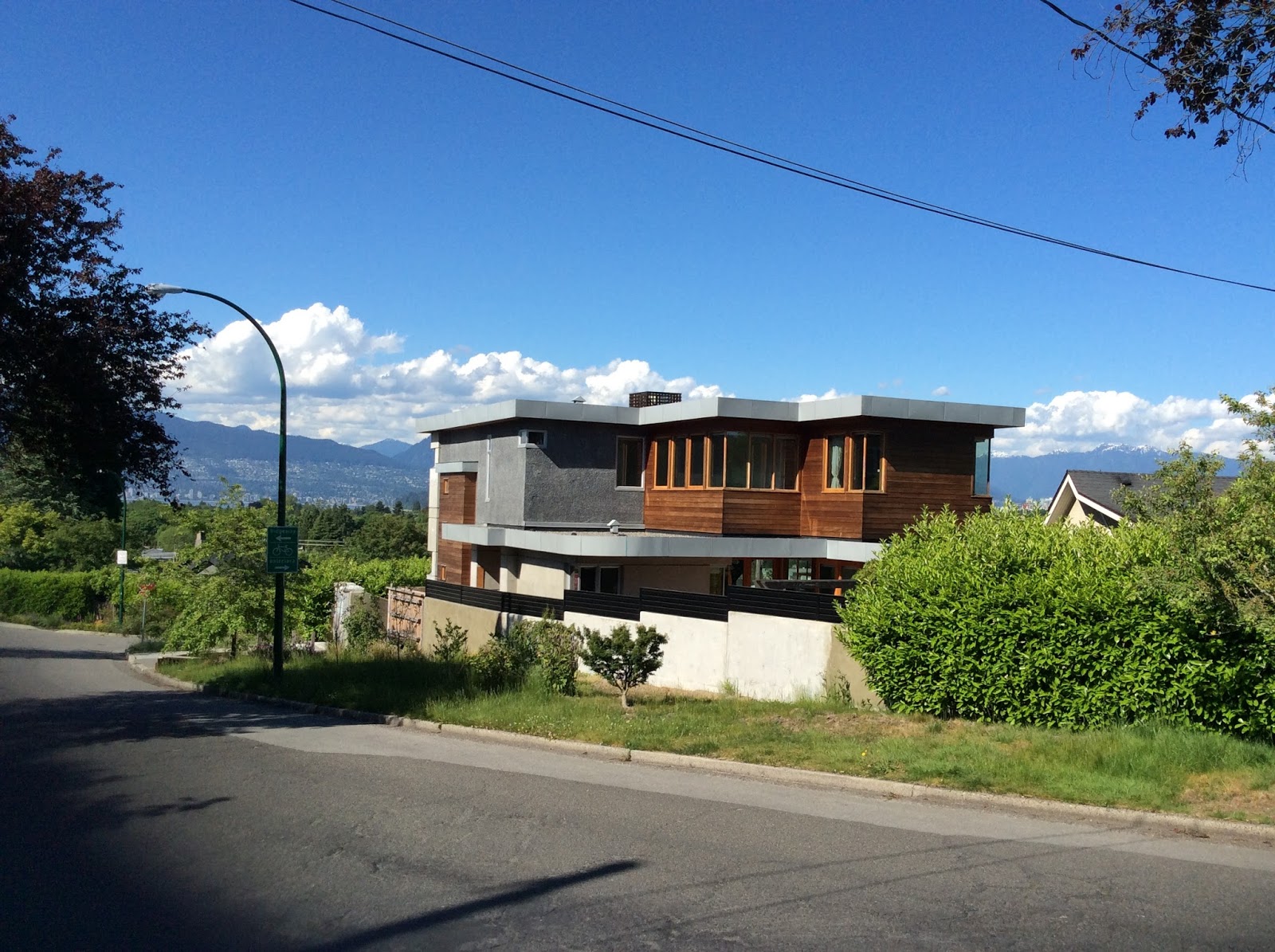
Oh, what I would give to know the real story about this house! It replaced a modest little bungalow five or six years ago, and it's been reworked, relandscaped and as far as I can tell -- unoccupied -- for most of the years since. This photo was taken this summer, when the house appeared to be deserted.

Just recently, a row of apple, plum and pear trees was planted on the boulevard outside the house. 


Every house develops a story when you walk past it every day, and I've been making up stories about this house -- with its spectacular mountain and ocean views at the top of the Dunbar hill -- for many years. In its original incarnation, it was a modest white clapboard bungalow with an ordinary garden, so my story was that an aging couple were living out their lives there, enjoying the view together.

About five or six years ago, it went up for sale, so my story was that one or both of the couple had died. When it sold, the little white house became a gigantic hole in the ground for a long time. The boxy modern one that emerged was occupied for a year -- exactly the length of time it takes to avoid the goods and services tax. As far as I can tell, it's been vacant ever since.

Last winter, somebody started reworking the fencing, redoing the driveway, built an elaborate new gate, and planted -- much to my curiosity -- four apple trees on the north side of the property. The exterior work continued for awhile, then stopped. In the summer, the place took on a deserted look, with construction partly finished, the lawn ragged with weeds and the apple trees struggling. I decided the owner had sold it again, and the new owner was having second thoughts about the renovations.

Then suddenly in late summer, the fancy new gate vanished, and more construction work and landscaping began. One day I passed to see the boulevard grass torn out, and workers planting new sod. By fall, everything was shipshape and shining: Surely the new owner would be settling in soon.

So far, not. But recently, somebody planted a whole row of apple, plum and pear trees on the west side of the house; a little linear orchard marching down the hill. My story is that whoever owns this house -- whether they ever live there or not -- really likes fruit.

This photo, taken during the summer, shows the overgrown grass and ragged shrubs on the boulevard. 

This photo shows the unfinished construction that sat awaiting completion for months.
Another view of the newly planted little fruit orchard. I hope somebody tends these trees!


Sunday, November 27, 2016

Journals

Oh what a fun idea it seemed when the professor said we'd be writing journals for this fall's course on Paradigm Shifts in Western Civilization. Journals -- the word conjured up those old five-year diaries I used to keep. Passing thoughts tossed lightly off; for an avid reader/writer like me, what could be easier?

Many things, it turns out. The word journal turned into "mini-essay" with all that entails. Three to four pages, with thesis, arguments and conclusion on nine texts and one film. The thing about essays is that you actually have to absorb the material to write one, no matter how short. Very clever on the part of the professor. Very gruelling for the students.

I will never confess how long these things are taking me, but let's just say I don't know how classmates who are still working full time are doing it all. As for me, friends know my efforts expand to fill the allotted time. So the journals -- plus the main 15-20-page essay -- will be done by deadline. But not a second sooner.

My latest so-called journal is a nine-page essay on violence and colonialism. It combines the works of 1700s writer/philosopher Denis Diderot, 1960s revolutionary writer Frantz Fanon and Gillo Pontecorvo's 1966 film, The Battle of Algiers. I'm not saying how many journals/essays are still on the drawing board.


Saturday, November 26, 2016

November garden


Every once in a while, the rain stops for long enough that I can take my iPad out into the garden to see what's happening. Here are some recent photos:


Mr. Darcy, the birdbath and a volunteer nasturtium.  I usually throw some nasturtium seeds in the ground in the spring, but this year didn't get around to it. Predictably, I had no blossoms all summer, but a few days ago, I noticed a spot of orange. And there it was -- a self-seeded nasturtium!

A closer look at the nasturtium. They're tough and often bloom far into the fall.

The star magnolia buds in the front garden, getting ready for the spring show.

The Pink Dawn Viburnum in the front is blooming now, and actually has some scent. 

These primroses were planted in the spring, survived the summer, and are doing their best to add some colour in the front rockery  now.

An avenue between the laurel hedge and a hydrangea bush in front. The little kids from next door like to play in this area. 

The weeping birch has lost its leaves, but still overhangs the hydrangea in front, which needs to be cut back soon. If  we had snow, it would be crushed.

These tree fungi aren't in my garden, but they made such a pretty pattern, I had to photograph them. 

A closer look at the fungi, which look like little umbrellas, up and down the tree trunk.


Friday, November 25, 2016

Gold letters on marble pages

I'm spending a lot of time with Virginia Woolf lately, as I'm writing an essay on her 1927 book, To the Lighthouse. For those -- like me up until now -- who haven't cracked it yet, it's about the big Ramsay family (eight kids), their friends and relationships, and their shabby summer house in the Hebrides. I'm focusing on other sections for my essay, so had forgotten the pure poetry of the middle section, "Time Passes," which describes what happens to the house, deserted during the war, as the seasons come and go. My friend Andre, a Woolf aficionado, brought it to my attention yesterday. I thought others might enjoy it too:

"But what after all is one night? A short space, especially when the darkness dims so soon, and so soon a bird sings, a cock crows, or a faint green quickens, like a turning leaf, in the hollow of the wave. Night, however, succeeds to night. The winter holds a pack of them in store and deals them equally, evenly, with indefatigable fingers. They lengthen; they darken. Some of them hold aloft clear planets, plates of brightness. The autumn trees, ravaged as they are, take on the flash of tattered flags kindling in the gloom of cool cathedral caves where gold letters on marble pages describe death in battle and how bones bleach and burn far away in Indian sands. The autumn trees gleam in the yellow moonlight, in the light of harvest moons, the light which mellows the energy of labour, and smooths the stubble, and brings the wave lapping blue to the shore."