Thursday, October 20, 2016

Fall at VanDusen Garden

I've made good use of my VanDusen Garden pass this year, as blog-watchers will note. Alone and with my friends Linda and Ros, I have recorded the seasons come and go. In fact, my first blog post in May was about the laburnum trees in golden bloom there. This week, Linda and I were back to see what happens in the garden in the autumn. Here's what we found:


A beautiful explosion of a reddish orange bush was worth having Linda pose beside, but unfortunately we didn't get its name.

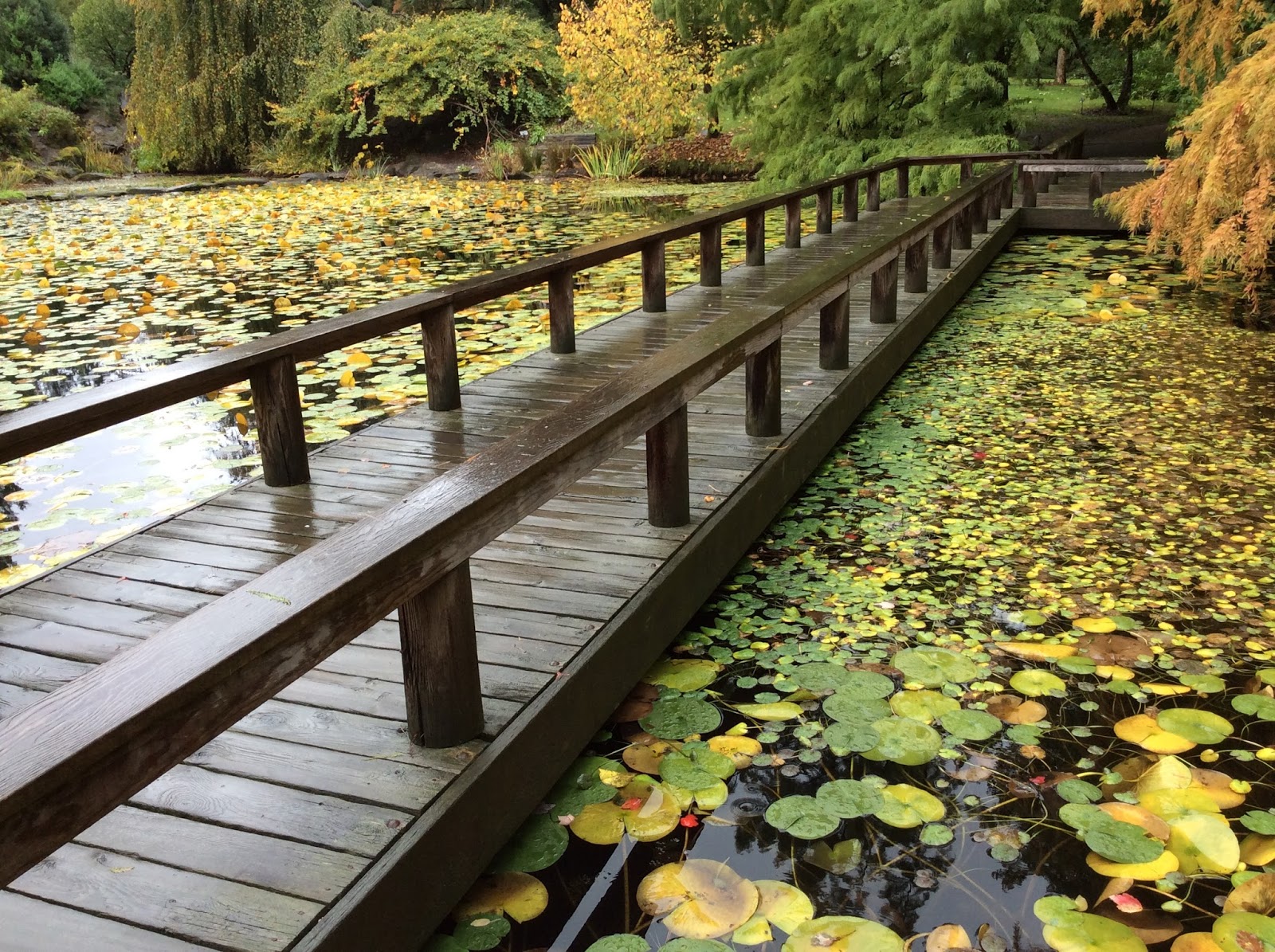
The wooden walkway through the lake is always one of my favourite spots. In summer, the waterlilies are pink and white. Now they are yellow and green, matching the foliage of the trees around them.

My friend Linda under her umbrella at a favourite picture-taking location in the garden. I never come away without several shots of this patch of water, this time with a background of red and orange trees.
One of the things I enjoy about visiting the garden is that I always find spots I haven't seen before. We discovered this cave-like avenue -- a little creepy -- just in time for Halloween.


The colourful Japanese maples turn this familiar entrance to the garden into a fall scene.

Water is intriguing any time of year, but the fresh green growth under the water makes this seem more like spring than fall.


I'm not sure what kind of trees create this splash of colour behind Linda, but I wish my garden was big enough for a similar stand.


I've seen coleus in colourful planters all over the city this fall. VanDusen has a few fine specimens at its entrance.


There's a big green patch of rhubarb-like gunnera leaves to the left of the waterway. They don't seem to be shrinking any as the season progresses.


This colourful scene is probably thanks to different types of Japanese maples.

I didn't see any water birds in the ponds this time, but with all this vegetation, there should be lots of food down there for them.

Just a nice tree with red berries, with water in the background. It looks like a scene from an English country estate.


A closer view of those succulent green plants that look like they might be edible. Where are the birds?


And back to my favourite spot, the walkway with the yellowing waterlily leaves.


Our surprising shelves

One of the many packed bookshelves in our house, hiding many, many books we have forgotten we own. John is more of a non-fiction reader, but Jane Austen and Kate Atkinson can do no wrong -- or ever write enough -- in his eyes. I am a fiction person, and while I like some of our new and emerging young writers, my go-tos  are always the older ones -- like Dickens, Trollope and the Brontes. Now that I know about Balzac, I'll soon be adding some of his 100-or-so publications to these shelves. 

John and I feel the same way about our book collection. The walls of books upstairs and down are our solace, our pleasure, our treasure chest. We both love the idea that we can dig into our shelves and emerge -- surprised -- with something good we have never read before. We add continually to our collection, although we occasionally have righteous bouts of paring and discarding. But the bookshelves are always overflowing, and surfaces in our house never stay bare for long.

When I realized I would be doing a presentation and paper on Virginia Woolf for my course this fall, the first place I turned was to my bookshelves. I've never been a Woolf fan, but she's one of those "big" writers I've always thought...well, maybe someday. When I emerged from my search, slightly dusty, this is what I had: To The Lighthouse (two copies); A Room of One's Own; Mrs. Dalloway; Woolf's Complete Shorter Fiction, and Virginia Woolf, A Biography, by her nephew Quentin Bell.

Who knows how all this found its way into my house? Here's a hint: Now that I'm starting to appreciate Woolf, I've been thinking about her other books, the ones I don't have. When I walked past  a second-hand bookstore today, it reached out and grabbed me, and sent me back onto the street with Woolf's The Voyage Out. I may not have time to read it now -- the presentation and essay and so on. But one rainy day, I will go to my bookshelf in search of hidden treasures. And there Virginia will be.

A search of my shelves yielded a surprising number of Virginia Woolf books. But there's always room for one more.

Tuesday, October 18, 2016

Autumn, Virginia

VanDusen Garden is a good place to look for the kind of scenery Virginia Woolf' describes at the beginning of  A Room of One's Own.  Across the water could be one of the willows she notices, weeping in "perpetual lamentation, their hair about their shoulders." 

And here is some of the fiery colour Woolf's narrator admires on the riverbank of the fictional town of  Oxbridge.
"To the right and left, bushes of some sort, golden and crimson, glowed with the colour, even it seemed burnt with the heat, of fire. On the further bank the willows wept in perpetual lamentation, their hair about their shoulders. The river reflected whatever it chose of sky and bridge and burning tree, and when the undergraduate had oared his boat through the reflections they closed again, completely, as if he had never been."

Virginia Woolf is known more for her interior consciousness than for her scenery, but she opens A Room of One's Own with this lovely description of a fine October day in Oxbridge -- a fictional combination of the venerable English colleges of Oxford and Cambridge. Her narrator is sitting on the banks of the river, surrounded by autumn colours, pondering a lecture she is to give about women and fiction. (She famously concludes: "A woman must have money and a room of her own if she is to write fiction.") I have just started reading the book -- shamefully, for the first time -- and am delighted it is conversational and readable, not the dull tract I had always feared. I was especially delighted because her opening setting -- October, water, glowing foliage -- made me feel right at home.

Another view of the water course at VanDusen. Perhaps Virginia is just a little further along the bank. 

This is a garden worker doing maintenance in the lake, not an undergraduate oaring along a romantic college river. But it's a boat, it's water, there are reflections -- close enough.

Sic transit gloria

 These tulips were glorious in the house for Thanksgiving, but didn't last long. A good lesson about transience, and all worldly things being fleeting. 

I don't know Latin, but a phrase floated up from somewhere as I tossed my "Thanksgiving" tulips on the compost pile. Tulips are a spring flower, so are totally out of season, but I chose them for their orangey-red that echoed the fall colours outside. Along with hydrangeas from my garden -- which are turning as many colours as a fading bruise as they age -- they were the backdrop for our recent Thanksgiving dinner. The hydrangeas will dry in the vase and preserve themselves indefinitely, but the tulips were more ephemeral. The first couple of days, they stood straight and chipper. The third, one bloom drooped. The fourth, half the blooms were aiming at the floor. On the fifth day, they were on the compost pile to provide food for the worms. As for the Latin, the full phrase is "sic transit gloria mundi,"  meaning "thus passes the glory of the world." The tulips' glory was fleeting indeed; the good old homegrown hydrangeas could be around until spring.

When I looked, I was amused at how often the Latin phrase is used -- no wonder it popped into my mind. Movies, songs, poems, and even newspaper headline writers have had a go at it. A New York Daily News story about a 1980 state transit bailout ran under the headline: "Sick Transit's Glorious Monday." It's also apparently the phrase used to warn triumphant Roman generals and new popes not to get too full of themselves, because, well, these things are fleeting.

The tulips on day one of their glory on the window sill; the hydrangeas are on the table, all ready for Thanksgiving dinner.

Three days in, one bloom is drooping. 

Four days in, and lots more are headed downwards. The hydrangea is hanging in just fine.

Five days and out. Something pretty for the worms to enjoy on the compost pile.

Sunday, October 16, 2016

Flying Emi

John catches Emi trying to zero in on the cheesecake her mom Aya is dishing up. Luckily, dad Etienne has a firm grip.
The photographs I post of our grandniece Emi often seem to involve her in motion up in the air. There were the photos of her flying as high as she could on a swing, the photos of her dad holding her  upside-down in a restaurant, the photos of her standing up in her stroller. I didn't catch her in motion, but she was bouncing up and down from a standing position, something passersby apparently find quite alarming (her parents know from long experience that she's okay). Here's another flying photo from a get-together this week. This time she's getting ready to descend on some cheesecake her mother is dishing out. Maybe a career in aviation is ahead!

After landing and polishing off that cheesecake, Emi is deeply absorbed by a Japanese cartoon featuring two little girls in a forest. Another photo from John.

Wednesday, October 12, 2016

We still have kitchens

Today was a cooking day, and I was feeling pressured because I had schoolwork on my mind. I wanted to focus on readings and essays, but groceries, food, cooking ... well, it has to be done, right?

Coincidentally, I had reached the part of an 1898 treatise by feminist writer Charlotte Perkins Gilman questioning whether most of us should be cooking at all. Cooking is a special field, like architecture, she argues, so trained experts, not amateurs, should be doing it. Eliminate the home kitchen altogether, she urges, and send the family off to a designated area outside the home for their meals. No kitchen, no onion smells, no cleanup!

As a feminist, Gilman's angle is that women -- "private servants" in her words -- have been unfairly stuck with the cooking duties, to the detriment of themselves, their families and society as a whole. But she doesn't stop at cooking -- women shouldn't be cleaning either. Once again, this should be the work of professionals who would whip regularly through people's homes, leaving women free to pursue their own careers.

Gilman, whose views must have been quite controversial when she wrote Women and Economics nearly 120 years ago, takes some ironic jabs at the contrast between the exalted view of women at that time and how they were actually treated. "It is woman, the dainty, the beautiful, the beloved wife and revered mother, who has by common consent been expected to do the chamber-work and scullery work of the world," she writes. "All that is basest and foulest she in the last instance must handle and remove."

The ashes and soot she refers to aren't part of the picture now, and household conveniences have transformed much of the drudgery she was referring to. But our homes are not the work-free oases of rest, privacy and beauty she was pushing for. We still have kitchens. And I still had to make a batch of spaghetti sauce.

Vanishing Halloween?

Nobody can say this household didn't go all out in creating a Halloween display, but there seem to be fewer such spectacles going up this year. 
A full-size coffin on a doorstep is perhaps taking the Halloween theme a bit far. But this household decorated the rest of their yard too, so they're taking it as seriously as the jolly-themed people above. 

Simple, but effective. A skeleton dancing off a bush.

For as long as I've been in Vancouver, Halloween has been the ever-expanding celebration. More and more houses decorated earlier and earlier with graveyard scenes, white garbage bags shaped as witches, and cobwebby gauze of all colours draped over hedges. Pumpkins are popular, but not nearly enough -- there are strings of skull lights, big puffy air-filled decorations on front lawns, and "Danger, do not cross" yellow tape crisscrossing pathways. Why the excitement? I always speculated it was because the wide diversity of people who now live in Vancouver don't necessarily want to get behind Christmas, so turned to Halloween as their blow-out celebration.

But this year . . . the oomph seems to be gone. Nearly halfway through the month, there are fewer displays than usual, and those that exist seem a little, well, deflated. I wonder whether the cumulative effects of the last decade of real-estate madness are showing -- so many houses are empty now, and none of those houses have little trick-or-treaters eagerly awaiting the big day. As a non-parent, Halloween has never been a big issue for me, but as a walker, I'm always interested in signs of what's happening in the community. I look forward to seeing what transpires this year -- is the ever-expanding celebration about to become, heh, a ghost of itself?

 
A cardboard portrayal of a pumpkin gets the idea across without all the mess and fuss of  a real pumpkin. Set in this well-landscaped garden, it is simple and strangely effective.

Oh now, this is tacky! A ghost-like figure -- what's with the tie? -- is popping out of a transparent air-filled globe containing a black cat and a pumpkin. This is in the same garden as the big orange pumpkin above, and the two displays below. I hope whoever did up this garden has lots of appreciative children around. 

An air-filled pumpkin with ghosts popping out of the top and out of the eye-holes. 

A witch by the front walk is supposed to be menacing in a child-friendly kind of way.

Much more menacing: In another garden, two translucent skeletons hang off a bush, fluttering in the breeze.

This is the "tombstone" filled garden of the house with the coffin on the front step.

Another look at that coffin, in its full setting. Skull-like green lights will likely be lighting the path on Halloween night.

Blended with evergreen swagging, these look like they should be Christmas decorations. But the colours and the owl-like eyes suggest Halloween. 

Yes, they did mean Halloween. Further along is this sparkly hot-purple version of a witch on a broomstick.

And, a jolly little ghost on a ball that once would have hung from a Christmas tree. If it works for Christmas, why not Halloween? 


Monday, October 10, 2016

Our Thanksgiving

My family never made a big fuss about Thanksgiving, a tradition John and I have continued. One year, we accidentally had the best turkey dinner ever in an unprepossessing restaurant on a day trip to the Okanagan. Perhaps my memories are sweetened by the fact that I had no part in the preparations or cleanup. This year, we celebrated by having John's cousin Janice and her husband Jim over for a quiet dinner (salmon, easy) the day before Thanksgiving. And today, the big day itself, John had lunch with a friend visiting from California, while I went for a walk. A glorious day, with the leaves changing and the trees glowing in the late-afternoon sunshine. Trees, nature, the ability to walk -- some of the big things in my life I am really thankful for.


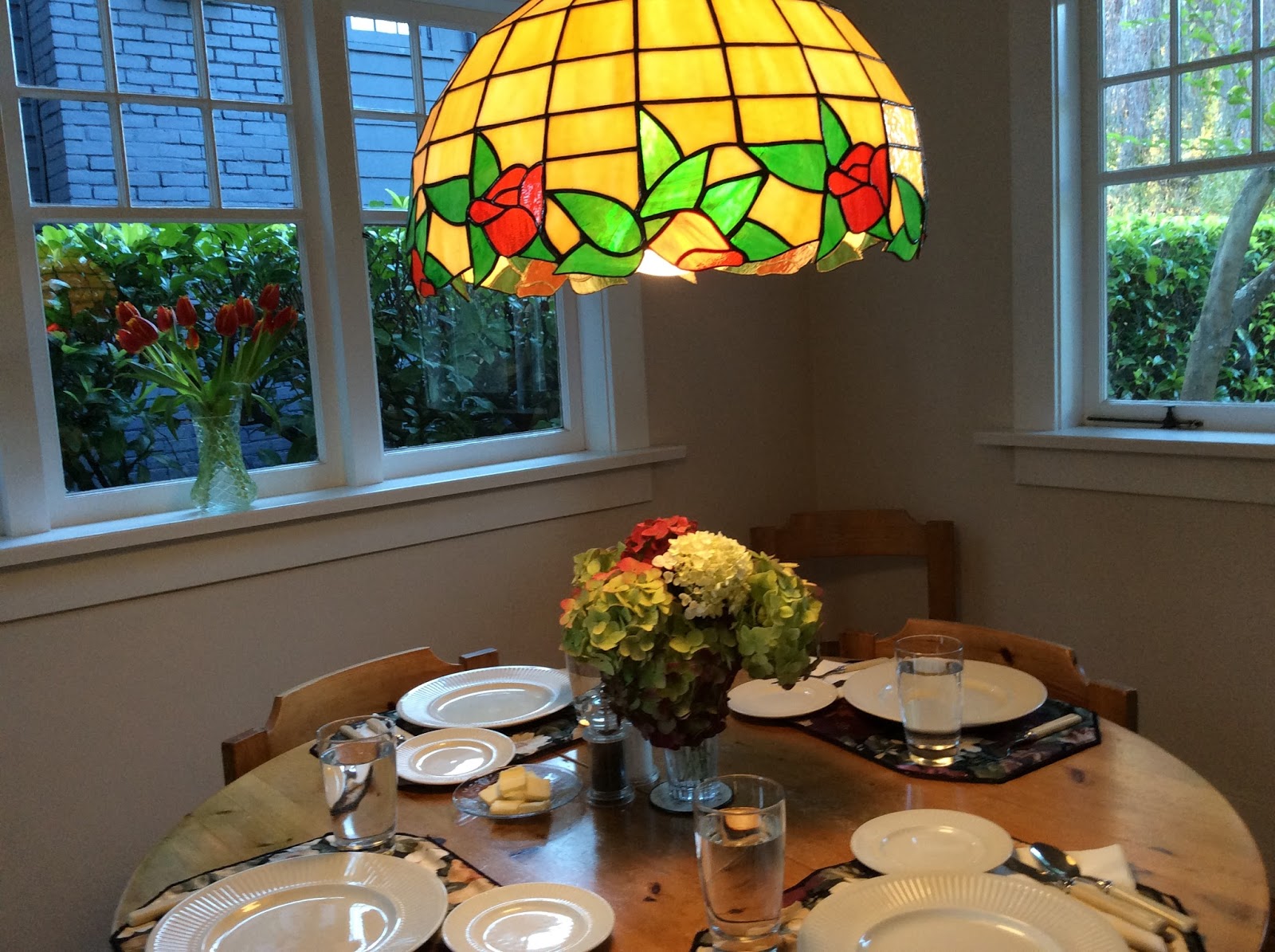
Table all set for non-turkey pre-Thanksgiving dinner. It is wonderful to be able to make as much or as little of this day as you want.

What better way to appreciate all the things we have to be thankful for than to  walk under golden leaves and a blue sky?

Look down, and some evil-looking mushrooms have sprung up, due to the rain we've been having lately. 

Another shining example of those golden leaves. 

And underfoot, multi-coloured leaves.  I can't look at them without remembering how the fall after dad died, I collected specimens of perfect leaves -- all types and colours -- so mom could put together a wall display for her new apartment. 

The orange construction fencing below is overshadowed by the bright colours above. 

These trees mark the outer border of VanDusen garden, which has beautiful trees. I didn't make it into the garden today, but even the exterior is a treat to walk past.
Chestnuts on the sidewalk. When the chestnuts are falling and the wind is blowing, it's a good idea to wear a hat.


Sun-drenched gold-orange leaves outside VanDusen garden say everything that needs to be said about autumn.. 

Along the streets, red trees stand out.


You've seen these hydrangeas on this blog before, but even as they dry up for fall, they're interesting. The well-sculpted red hedge behind adds colour. 


Most of our views are obstructed (enhanced) by trees, but we can see clouds and even the distant mountains by going to nearby  Balaclava Park. If you go at the right time of day, you can see dogs bouncing and playing together on the grass.

I took this because the trees are almost as red as the car. It's kind of a John picture. 

And, a street in Kerrisdale. beautiful, and empty. There weren't many people on the streets today -- it was like having my own private park. 


Sunday, October 9, 2016

The Finnish way

We often hear about how great people in northern European countries have it compared to North Americans -- they pay high taxes, yes, but they have cradle-to-grave assurances they won't go hungry, homeless, doctorless or toothless. Free university education, good care for children and the elderly, and so on.

Well, according to a Finnish writer who followed her fiance to the U.S. in 2008, it's all true. Anu Partanen thought she was leaving the safety and complacency of Finland for a place where people craved "liberty and a chance to excel." What she found was that Americans may depend less on the state, but they depend more on others like their employers and relatives. They cling to hated jobs for the health care attached, and live off their parents into their 20s and 30s because of high student debts.

"The Nordic system is intentionally designed to take into account the specific challenges of modern life and give citizens as much logistical and financial independence as possible," she writes in a book about her experience. Walrus magazine editor Jonathan Kay, who has written a column on her book, notes that what she found in the U.S. was an "agitated population beholden to their spouses, parents, children, colleagues, and bosses." He says he saw the same thing when he lived in New York City in the 1990s, where except for the one percenters, "everyone I met was living in some kind of cage."

Kay notes Partanen was "especially horrified" by the lot of American women, finding that in some states, they had so little protection that they were pressured into returning to work within weeks of giving birth. And, he says, she argues that the "unforgiving nature of American economic life helps explain why so many American women are obsessed with finding rich husbands." (I will refrain from a Donald Trump reference here.)

Canada offers more help to its citizens than the U.S., but Kay says our country could still benefit from taking a look at places like Finland. "The argument is not one of freedom versus dependency,"  he writes. "We are all dependent on someone -- the only question is whom."

( Kay's column is in the November 2016 issue of the Walrus magazine. Partanen's book is called The Nordic Theory of Everything.)