Friday, May 22, 2020

Reviving mom's buns

Here I am, trying to channel my mother after I found her old recipe for hot-cross buns. I'm showing John how she used to squeeze the dough through her thumb and forefinger to create a perfect sphere. Photo by John Denniston. 

Mom wrote out her favourite recipes by hand in an old blue ledger. As you can see from the well-spotted page, this recipe must have been used often. For our family, hot-cross buns were a year-round phenomenon, not reserved for Easter.  Photo by John Denniston.

John’s recent venture into Covid bread-making got me thinking about home-baking and the long-forgotten taste treasures of the past. Oh! the memory of mom’s hot-cross buns, fragrant with cinnamon, browned and puffed, studded with just enough raisins to make each one a treat.

Could they be revived? Six years since she died and at least 10 years since she last made it, could mom’s best bun recipe live again?  Diving into the drawer where I keep such mementoes, I found the hard-cover blue ledger where she wrote her best recipes in a fine and ladylike script unknown to the block-letters-and-computer-keyboard children of today. Five pages in, at the top of a reassuringly well-spotted page, is “Hot-cross buns.”

What’s curious about such recipes, from those whose lives have centred on the kitchen, is what they don’t include. A list of ingredients, yes, and amounts to some degree, but “a few cups” of flour? Whole wheat or white or a mixture? I recall these as whole wheat buns, but the recipe gives no clue. No instructions on kneading times or cooking temperatures and should there be a second rise or is one enough? –– the assumption is that the baker will just know. Such recipes are guides for the knowledgeable.

The best part about the results was the smell – the fragrance of baking bread and cinnamon that I remember so well. The actual buns, well, let’s just say they are a start if I want to figure out my own way of making them. They probably needed more kneading, more rising time, and should have been baked closer together. They had a crusty exterior instead of the soft one I remember, and once cooled, settled into a certain solidity. Mom had a term for such results, and I fear she would have called them “toughy-duffies.”

 John, lacking the idyllic memories of the original, thought they were just fine.

Yes! Yeast has returned to store shelves, and here is my stash.
Since I remember mom's hot-cross buns as being made of whole wheat, I waited until whole wheat flour returned to store shelves before I tried her recipe. The only problem is that it was only available in 10-kg bags. That's a lot of baking ahead!


The makings of the recipe: milk, butter and eggs to the left,  foamy yeast in the measuring cup in centre, bowl awaiting the finished dough to the upper right, and flour and raisins on the lower right.
"A few cups of flour" with the liquid ingredients added. Much more flour was needed to turn this into bread dough.

Dough in greased bowl, ready to rise.

Risen dough: is it double the original as instructed?

This old work-horse of a baking pan is what mom used to bake her buns on. Since I inherited it, I've used it for almost everything, especially baking salmon. It's showing its age, but I hope it lasts me out.

Cutting up the risen dough to make into buns. Photo by John Denniston.


Shaping the buns. Photo by John Denniston.

 I wish mom had been around to give me spacing instructions. Photo by John Denniston.

Ready for the oven.


All cooked. Hmm. They don't look like mom's evenly-sized, closely packed buns that covered the entire pan. I guess this is how you learn!

Close-up of mom's recipe in case anyone else wants to take a shot at it!

Mom's blue ledger with her favourite recipes hand-written inside.


Thursday, May 14, 2020

Spring resurgence

John and I have been really good about staying in our neighbourhood during the pandemic, but every once in awhile, we just have to break out. On Wednesday, a month and a half after our last such visit, we returned to Richmond's Iona Beach regional park for another walk on the north arm jetty. Lots has changed; spring has transformed the landscape, and the easing of pandemic restrictions has brought some life back to the adjacent river and the airport. All photos by John Denniston.

The trees have leafed out and the yellow broom has turned some formerly bare  areas into idyllic pathways.

Getting into the sparser, sandy area, I was surprised to sniff the scent of wild roses and see a patch of pink. I don't know what kind of roses these are or why they would have appeared here, but they look like low-growing, large-flowered variations of the Alberta wild roses I grew up with. 

Nearby, poking up amid the sand grasses, are these blue and purple flowers. A Google search shows they are either wild sweet peas or vetches. 

Here's a bank of these same flowers, with the Fraser River and a log boom in the background.

These are probably the rankest weeds, but they were red and looked pretty against this log. Let's call them spring flowers.

Iona Beach was a silent and stripped-down place when John and I walked its north arm jetty at the end of March. All was Covid-era quiet – no action on the river on the one side or at the airport on the other. The scenery was beautiful, but the beauty was in its austerity – in the blue-grey horizontal lines of ocean, sky, sand and water, relieved by the vertical pops of skeletal trees and log-boom pilings poking out of the sand.

A month and a half later, it’s all coming back to life. When we walked there Wednesday, planes rumbled to and from the airport, and on the river, tugboats nudged the log-booms, with pole-wielding crewmen doing their dangerous dances on the logs. On the jetty itself, spring had exploded. Broom turned the river banks electric yellow and leafed-out trees transformed once-bare paths into idyllic byways. On the bleak sand wastes, the usual coarse grasses were interrupted by sudden surprises –a patch of pink that turned out to be heavily scented wild roses, and a bank of blue-purple flowers  foregrounding the river scenery.

It’s a coincidence that the shutdowns of economic and social life due to the coronavirus are lifting just as spring resurrects the natural world. But appropriate, somehow. Even broom, wild roses and wild sweet peas can only stay dormant for so long.


The north arm of the Fraser River, virtually deserted during our last visit to the park, is showing signs of life again. Tugboats were busy moving log-booms around.  

Spring is greening up the rough grasses growing among the rocks of the ocean shoreline.


But even spring weather doesn't make the sand grasses luxuriant. That's why a patch of roses in the midst of  such terrain was a big surprise.

This log photo could have been taken in March, but I include it here because it shows the unchanging beauty of the area. 

And this one shows the grasses, sand and broom that made this visit so different.

As we left, the skies were darkening;  the broom's yellow blossoms shone as bright as electric lights against the gloom.

Layers of different kinds of plants under those impressive skies reminded me of a painting by Kathy Robertson, a beloved Saltspring neighbour who unfortunately is no longer with us. I think she would have enjoyed painting this scene.

Tuesday, May 12, 2020

Sharing the wealth


Lilacs, apple blossoms, that big old red azalea out front, and the gold of the golden chain tree – right now is the best time in my garden, and recent sunshine has made it positively idyllic. Since distancing rules make it hard to share the pleasure with friends, here are some glimpses of what I’d like everyone to be enjoying along with me:


What an early-morning view! Out of the bedroom window, our neighbour's apple tree is in full bloom to the left, while our lilacs form a counterpoint to the right. 
Down the back steps, you're surrounded by colour. The summer snowflake is the white bush to the left, the pink wiegelia is to the right, and in the middle, the golden chain tree (laburnum) provides a vertical contrast. 


The lilac tree to the right was missing from the previous photo, but it's hard to get it all in!
Another view of the neighbour's apple blossoms, which are unusually prolific this year.

It was an accident, but the tree peony I bought a few years ago is exactly the same shade of pinky-red as the long-established big azalea out front. Luckily, they both are blooming at the same time. 


The snowball tree by the side of the house is just coming out into bloom, adding to the feeling of luxuriant plenty.


This garden bed mixes veggies and flowers; there will be lavender blooming here soon.

The lily-of-the-valley, which has taken over the space under a hedge by the side of the house, scents the yard in the evenings.

A close-up of the bleeding hearts; you can see the little white hearts bleeding away.

All the  plants I put into this new strawberry bed a couple of weeks ago seem to have taken hold, and look like they're flourishing.

No blooms yet, but these sweet peas planted from seed appear to be well on their way. Lots of tying-up to be done soon!

The beginnings of summer feasts of snow-peas, I hope. 

And here is the veggie garden by the back fence that I've written about before. John seems to have stopped the feasting critters by surrounding the plants with boards. I hope it keeps working. Photo by John Denniston.

This is what the back garden looks like now, with tomato plants up against the screen and rows of peas taking the place of the plants eaten by critters earlier. Photo by John Denniston.

And what you'd see at the front sidewalk if you were visiting today. The red azalea dominates, but the volunteer poppies provide a little spark of extra colour. 


Thursday, May 7, 2020

An unlikely baker


My partner John Denniston with the first thing he has ever baked in his nearly 75 years. Stunning what a long stretch of pandemic isolation can do! He set up this photo of himself for a Facebook post; note the T-shirt.

As someone who believes food is more fuel than pleasure, John has never been much interested in its creation. To him, cooking is a mysterious activity carried on in another realm that is not photography, bicycles or computers. So it was with amazement that I learned, a few weeks into pandemic isolation, that my partner of nearly 50 years had heard the call of the bread-making hordes. The most unlikely males of the neighbourhood were turning to baking; Facebook acquaintances were peppering the site with their golden loaves. Whether from boredom or a desperation for something new, John expressed interest in joining the action.

By then, of course, we’d missed the boat. The pandemic baking flurry had emptied store shelves of both flour and yeast. At Stong’s, a hand-written, capital-lettered “No Yeast” sign in the baking section had a beleaguered air. Too many requests, obviously; and there was no hint as to whether we’d ever see yeast there again. But a couple of weeks later, I scored a big bag of all-purpose flour, and recently, a box of instant yeast. Both were limited to one per customer, and neither were familiar brands, but one of the lessons of a pandemic is that you take what you can get.

Which led to Wednesday, with John up to the wrists in goopy bread dough, and me, decades after last making yeast bread, trying to offer advice. How much flour can you add to a watery dough before ruining it completely? What’s the right way to knead, and how do you know when it’s enough? John seemed to be prodding the dough very delicately, while I remember mom –a farm wife who made bread instinctively and often – pummeling it, her muscular forearms in action. Our dough rose quickly enough, but to my eye, it had a discouraged, baggy look compared to the smooth elasticity of mom’s efforts. As we bumbled along, John and I reassured each other that it was an experiment after all, and six cups of lost flour wasn’t the end of the world.

Nobody was more astonished than us when our two loaves turned out fine – nicely textured and tasting just like freshly baked bread should. Add it to the already long list of pandemic amazements. As for whether John will add baking to his long-term realm of interests, I have my doubts – but he could surprise me once again.

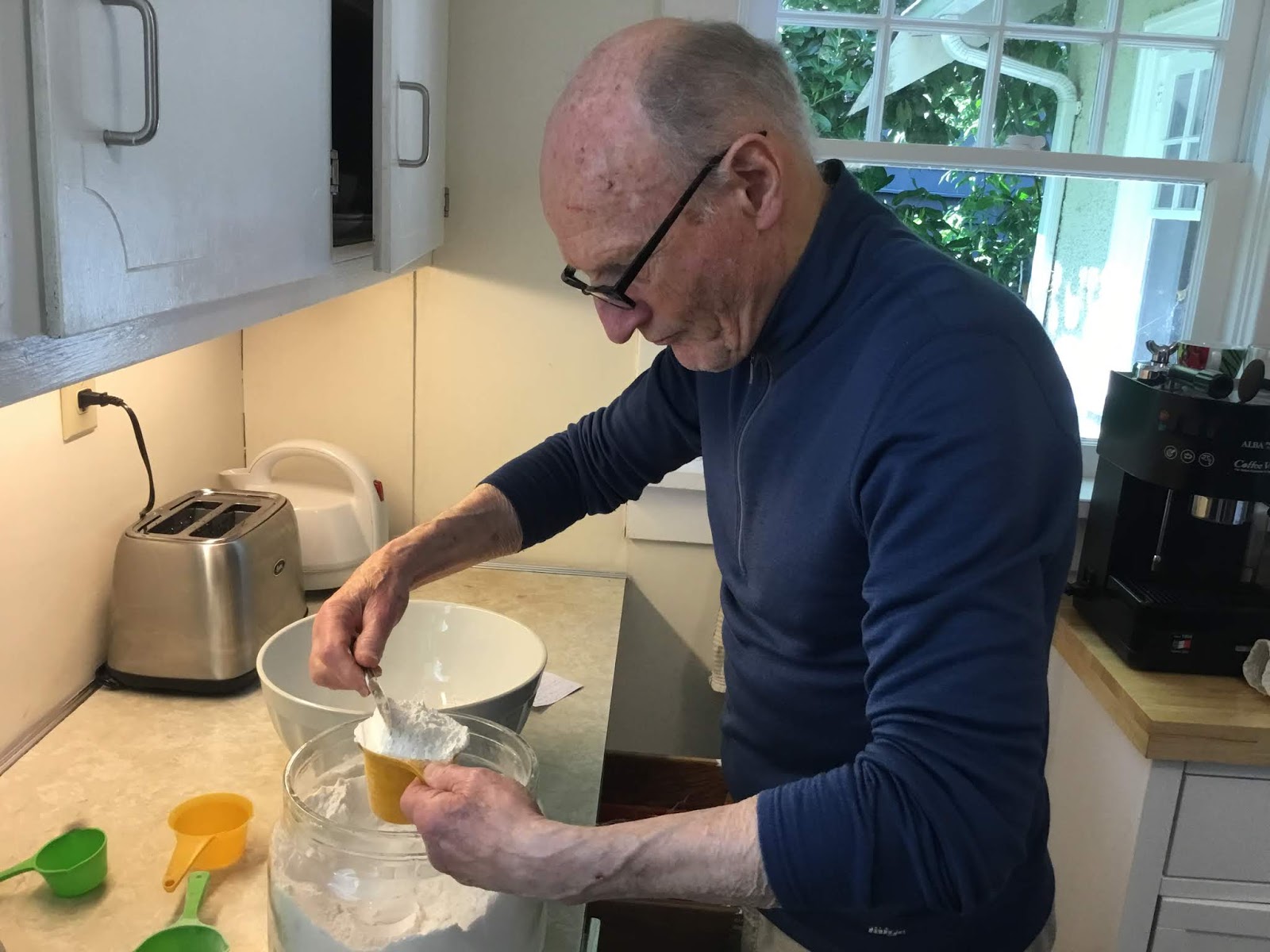
Here's how John's first baking lesson went, starting with measuring out the flour.

Pouring water into the flour-yeast mixture. The recipe said warm-hot -- which is what, exactly?

The dough ready for action.

It was pretty mucky, so we added flour, and more flour, far more than the recipe called for. How much is too much?

John kneading the dough. We looked up a YouTube video to see how it should be done, but the beautiful blond teacher seemed more interested in facial close-ups than in what she was doing with her hands. Not much valuable instruction there.

The kneaded dough ready for its first rise.

A much-anticipated section of the recipe called for "punching down" the dough after it had risen. John prepares for the punch....


... a satisfying squish...

.... and a fine hole in the centre, which seems to delight John. I had to tell him that it wasn't just one punch; he had to knead the whole thing again.


Cutting the kneaded-down dough for placement in loaf pans.

The risen loaves looked a little loose and baggy to me, not like the smooth elastic ones I remember mom producing. It was at this point that we began talking about what to do with two inedible loaves.

Into a 400-degree oven for 40 minutes . . .

. . . and out again. Looks done!


So, will they be edible?

The big cut.

Hmmm. Looks okay. At least it's not doughy in the middle.

The texture at least simulates that of real bread.


And, amazingly, tastes like it.There's no end to the surprises this pandemic has wrought!