Monday, April 6, 2020

Tree-watching


One of the highlights of  Covid-era life for many of us is our daily walk. Fortunately, there's lots to look at at this time of year, as the neighbourhood trees are doing all kinds of interesting things. I'm the main tree-spotter on our walks, as John's attention tends toward bicycles and other wheeled things. But he has the good camera and the professional eye, and gracefully obliges when I suggest a photo. Here's a look at what the trees are doing in our area these days: 


This magnolia tree was all bare branches except for several bright blobs that looked like forgotten Christmas ornaments. Photo by John Denniston.

One of the other buds on that same tree, eye-catching against the grey fence. Photo by John Denniston.

Some trees are still bare at this time of year, giving a clear view of what's beyond. Photo by John Denniston.

On the other hand, some trees are already going full-tilt, with a full set of leaves and an abundance of blooms. Camellias keep their leaves year-round, and some begin blooming as early as November. Photo by John Denniston.

Magnolias and cherries make a gorgeous combination. Photo by John Denniston.


Wouldn't you love to live in this old-fashioned cottage, looking out onto magnolias and forsythia in the sunshine? Photo by John Denniston.


This was taken a few weeks ago, when the cherry and plum blossoms first started. A spectacular show for whoever lives in that house and on that street. Photo by John Denniston.

This beautifully twisted tree base, combined with daffodils, made a pleasant spring scene. Photo by John Denniston.

Magnolia buds against a stormy sky caught our eye on a recent walk. It will look very different when all those buds are fully open. Photo by John Denniston.

The straight line of a hedge, topped by a froth of cherry blossoms. Photo by John Denniston.

This enthusiastic forsythia bush wants to take over the sidewalk. The gardening lore is that when the forsythia blooms, it's time to prune the roses.

Those yellow blooms close up.

This star magnolia to the left and tulip magnolia to the right are what we see when we open our front door at this time of year. Spring is definitely the best season for our front garden!

What our neighbours see of our spring trees when they take their daily walks.

Saturday, April 4, 2020

From veggies to flowers and back again

Ever since we bought our house in Dunbar in the mid-1970s, I have grown only flowers. But now perhaps it's time to return to my farm-girl roots and try to raise some vegetables, especially since the Covid panic is making grocery shopping uncomfortable. Unfortunately, as I well recall, veggie gardening is hard work. John found that out for himself  when he cleared out an area by the back fence for our vegetable plot. Here he's hauling out a big rock; see his video at the end of this post for the entire process.

This area housed a decaying compost bin for decades, which seems to have left behind some beautiful soil. This is the fine pyramid John created when he dug up the area and filtered out the detritus. 

The cleared-out area, with the soil spread. We'll replace the back fence with something more see-through to allow the sun in, and cut back the laurel hedge further.

For most of my life, I’ve had the great luxury of being a flower person. Even though I grew up with not one, but two, vegetable gardens, it was roses over radishes as soon as home-ownership gave me the say over a chunk of garden-able land. I delighted in forests of six-foot-tall blue and purple delphiniums, banks of white daisies, towers of multicoloured sweet peas, and pink climbing roses that grew so high they had to fall to earth again.


My flower-filled garden in summer; veggies are never as spectacular as this!
Now that the Covid pandemic is turning everything upside down – and emptying some supermarket shelves – I’ve been thinking about my gardening choices. Why no vegetables? Especially since I know as well as anyone that fresh home-grown anything is immeasurably better than anything from a store.

The answer may lie in the job jar that mom would produce every Saturday morning. My siblings and I would reach in and draw out thin slips of paper on which would be written, in her fine, ladylike hand, tasks like, “weed two rows of carrots” or “pick and shell one row of peas.” Gardening, I learned early, was hard work, involving lots of what we’d now call “stoop labour” – you bend over, for a long time, usually under a hot sun.

But I suspect something deeper was also involved. My parents had two gardens – a little one near the house and a big one near a slough for water – not because they loved gardening or the taste of fresh vegetables particularly, but because there were seven people who had to be fed all winter long. That meant canning beans, peas and other vegetables all summer and filling the cellar storage bins with carrots, onions, turnips and a truckload of potatoes every fall. Vegetables were a biting necessity in my childhood, and oh! the luxury of not having to grow my own as an adult.

Things have shifted lately, as I have said. When a friend in California recently announced he was starting a vegetable garden because pandemic panic had made it hard to find certain produce in the stores, John and I began eying our own garden differently. Within a week, he had torn apart a decaying compost bin near the back fence, dug down deep, hauled out rocks, and sifted the soil to create a respectable-sized vegetable plot. We’ve ordered seeds and are considering the seedlings now beginning to show up in stores. After decades as a flower person, it may be time to learn what my parents knew about surviving hard times. 


My delphinium beds, shown at their beginning last summer, will remain in spite of our new venture into vegetables.

And I'll still be growing sweet peas, shown here with the white daisies in the background.

I've already planted the seeds for this year's sweet peas, but they're a long way from looking like this.


This year's blossoms so far include mainly hellebores (white) and blue hyacinths, at the front of the house.


Tuesday, March 31, 2020

Something completely different

Tired of Covid-19-related conversations, e-mails and news? So are we. On Tuesday, John and I decided to head to Iona Beach Regional Park in Richmond to look for something completely different. We found silence (in spite of the proximity of the airport), fresh sea air, and sweeping views. It was like a trip to another world. Here are some photos from the day; all except the first are by John Denniston.

John with camera balanced on a log near the end of our walk on the North Arm Jetty. We chose the longer, more rugged route over the more cultivated Iona Jetty because there were fewer people on it. Less dodging of strangers, fewer chances to overhear Covid conversations. 
The route is interesting because of its variety. In this section, I look like I'm in the middle of a country walk, but not far away is the oceanfront.
I


At the start of the walk, you pass massive piles of bleached logs and other wood detritus from the beach. 

All those abandoned woodpiles have a bit of an apocalyptic feel. Better not think that way!

Even though the park is close to Vancouver International Airport, the silence was impressive. We heard only about six planes in two hours; at times the only noise was the howling of seagulls. A man we met along the trail said the park hasn't been this quiet since the World Trade Centre attacks. 

On our walk out, the ocean is to the left, the river to the right. If we walked right across the river, we'd end up at the University of B.C.


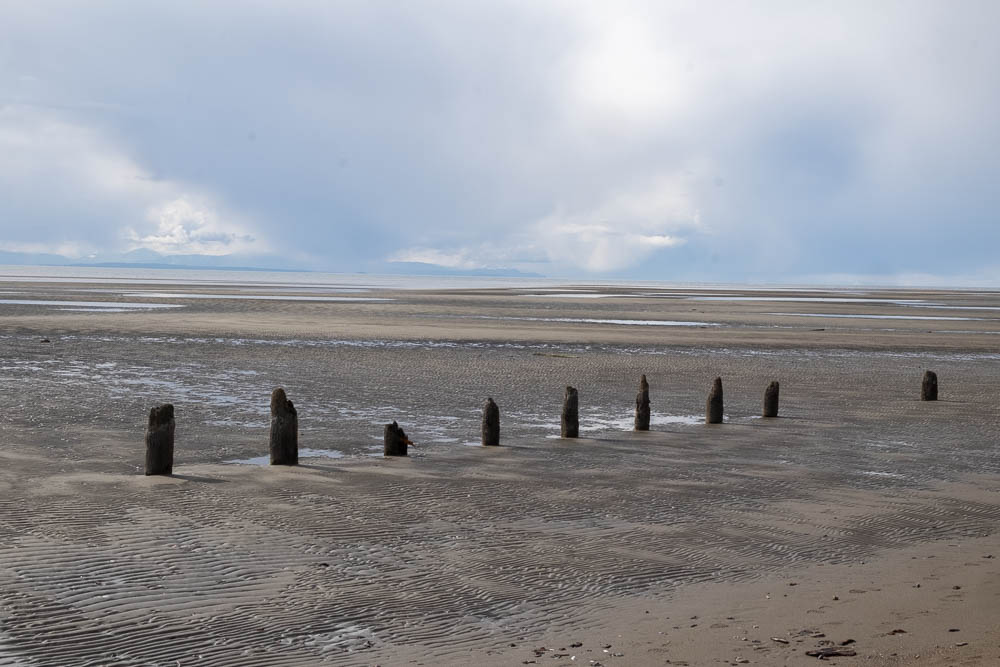
Pilings from old booming grounds stick out of the ocean sand.

The walk back: river, Carol, rocks and ocean.

Eroding sand below the dyke forms interesting patterns under a cloudy sky.

A bleached-out tree lies in the sand, decked out with ropes for an unknown reason.

 A quiet pathway through the trees, where we're told the birds like to hang out. We saw only a pair of crows here, but maybe they have company at different times of the day. Iona Beach is famous for its wide variety of birds because it is part of a migratory flyway.

Friday, March 27, 2020

Amusing ourselves in COVID times


In normal times, my friend Linda and I would never have made a date to exchange a bag of quarters and a mason jar of bleach, nor would John have made a video of the proceeding. But these are coronavirus times, when closed bank branches have made quarters scarce for Linda’s co-op laundry machines, and my local store shelves are stripped of bleach. Since we each had plenty of what the other needed, the solution was obvious. For John, who is running out of subjects for the video techniques he’s perfecting during his home confinement, we were convenient moving objects.

And so, in a parking area at Linda’s False Creek co-op, we converged. The choreography was fine: Linda emerged from a co-op door with what looked like the biggest urine sample ever and placed it on a ledge. At the proper coronavirus distance, I placed my offering on the same ledge. She picked up her quarters and backed away; then I picked up my jar, and John videoed away like mad.

It was silly and it wasn’t the weekly walk-and-talk that Linda and I usually share, but I think it was also important. Beyond the bleach, the coins and the video, it was a reminder that we are all there for each other in abnormal times.

Here we all are: I'm on the right, reflected in the glass, Linda is in the middle, and there's John photographing away on the left. Photo and video by John Denniston.

Thursday, March 26, 2020

Death by shopping


A friend blanched the other day when I told her I had gone into a garden centre. “I would never do that,” she said, a quick flick of the eye indicating she was making sure she was at least six feet away from me. I defended myself: “Well, I didn’t touch anything, and there were hardly any people there.”

What strange times these are. Shopping – the lifeblood of capitalism, the beloved, venerated hobby of many – has transformed itself within weeks into a dangerous, questionable exercise. For the old and the immune-compromised, picking up a jug of milk and a few tomatoes is being seen as tantamount to a dance with death. Adult children beg their parents not to set foot in stores; neighbours and volunteer agencies offer to take on the job for them.

Many of my friends say people have offered to shop for them, but they’re hanging on to this little piece of independence – “for now.” I haven’t had any such offers, but I’d probably react the same way. Shopping is a personal thing – the shade of green bananas you like, for example, and whether the broccoli wiggles limply under your fingers or has a nice snappish feel. How scared – how convinced – do you have to be to turn the job over to someone else?

Now the handling of those supplies when you get home is becoming just as fraught as the shopping itself. Videos are circulating warning that the virus lasts on plastic bags for days, and prescribing elaborate measures for thwarting it. Bananas, oranges, apples and avocados must go into soapy water for a good scrubbing. Boxes must be quarantined away for the appropriate number of days. I do not know the legitimacy of any of these warnings; I haven’t seen them addressed by any official agency. But they add to the uncertainty that has turned the most banal of activities into a passage into fear.

Aside from the dangerous escapade of entering a garden centre (to check for vegetable seeds in hopes of reducing future trips to the grocery store), I am restricting my shopping to once a week. No more dropping in every day or two to pick up something missing or check for the right kind of bread.  At 7 a.m. on Friday– seniors’ hour at Stong’s, with hopefully hardly anyone there – I will put my life on the line once again.

This is what shopping in coronavirus times really looks like, in contrast to John's lighthearted video at the start of this entry. The reality is waiting in a lineup in early-morning drizzle to just get into the store, then deciding to double up on everything to delay the next shop as long as possible. Even though Stong's controlled entry to the store, its narrow aisles made it difficult for customers to stay the proper distance apart. Not the breezy in-and-out venture I had so blithely predicted the night before. Photo and video by John Denniston. 

Tuesday, March 24, 2020

Signs of crisis times

I've been noticing all the signs lately that show how our world is changing because of the coronavirus crisis. This one, on the door of the Dunbar branch library, makes me think it will be a long time before I'll be sauntering up the street to pick up a book there again.

Sweet Somethings, a little coffee shop and bakery, has been a favourite spot to meet friends for lunch in the two years it has been open. Judging from the signs on the door, it made a valiant effort to keep going before bowing to the inevitable. 

This is one of the signs outlining the many measures the owner took to try to keep the bakery open. I suspect little locally owned shops like this one will be hardest hit by the crisis, and our neighbourhood will lose as a result.

I include this restaurant because it has been one of the Dunbar street staples for as long as I can remember. It had no more luck staying open than the two-year-old Sweet Somethings.

The Cosy Inn's hand-written, but very precise, closure sign. Its regulars will miss it.


Keep your distance. Go away. Closed. There’s a cold feeling in my little local shopping area these days, with one store after another lining up to tell customers that they are – for the good of the community and for themselves – not wanted very much, and often not at all. Thanks to the coronavirus, virtually all of the small stores in one two-block stretch of Dunbar are shuttered, or offering service so restricted that it amounts to the same thing.

The physical signs – the pieces of paper on the door of each of these shops – are also signals of how the coronavirus is turning the accepted norms of our society upside-down: Don’t connect, at least not physically. Don’t shop, unless it’s for essentials. Don’t linger in public spaces; as our prime minister says: “Go home and stay home.”

So, no more avocado toast with friends at brave little Sweet Somethings, a two-year-old coffee shop and bakery trying to defy the odds of survival in high-rent Dunbar. I’ve tried to support it, but the signs on its old-fashioned doors recount a losing battle to the virus – the hiking of sanitation, the banning of cash, the shifting of seating, the switching to paper cups, and finally, closure. Nor will I soon be dropping into the comfortable elderliness of the local library branch, with its hard-copy newspapers, books and wall of dated DVDs. Its front-door sign shouts “stop” in vivid red, and it's hard not to think that means something more symbolic than a simple closure for public safety. I can still get medications (toilet paper is iffy) at Shoppers, but first must brave a large entrance placard warning me to stay away if I’m sick. The shuttering of Starbucks has removed the outdoor tables, with their (usually) dog-owning patrons, from the Dunbar street scene, while the Cosy Inn restaurant, which has survived for decades here, is temporarily closed. Several bank branches, which usually tout their extended hours on their doors, have drawn down their blinds and posted signs directing customers elsewhere. Stong’s, the only source of groceries in the immediate area, remains open, but a smattering of warning signs on its doors reveal progressively more restrictive policies to deal with the crisis: no cash, no bottle returns, a reminder of social distancing, and the institution of special hours for seniors.

The collective impression is of an area shutting down, upending all the usual conventions in preparation for tough times ahead. But there are other signs out there with a different, warmer message about dealing with the crisis. During a walk one day, I was halted by a chalk scrawl beneath my feet: “Spend lots of time outside,” it said. A few blocks over, on another corner, was “Think positive thoughts.” Then I found “Kindness matters,” and “Celebrate for no reason.” Another day in a different part of Dunbar, I found “Stay well,” and “Peace and Love,” surrounded by hearts in pink and yellow chalk.

There are the necessary signs of a shutting-down city, trying to keep its residents safe and supplied with essentials. Then there are the signs made by people who know what that will cost us.

This was one of a number of chalk messages I saw during a walk one day. Somebody understands the toll the shutdown of everything is having on the human psyche.

Another positive sign, another day. Farther up, by the garden bag, are the words: "Stay well," followed by hearts and "Peace and Love."
This sign was further afield from the Dunbar shopping area, but signalled a similar impact. It says this Little Free Library is shutting down because of fears of coronavirus contamination.  Another loss, however necessary, to our civic connections.


A few days before I encountered the Little Free Library in the photo above, I spotted this one cleared of books. There was no sign explaining why, but I assume it was also because of coronavirus fears.

Another sign of the times marks the entrance to Camosun Bog in Pacific Spirit Park. The park is still open, but the sign reiterates the importance of people staying six feet apart, even while enjoying the outdoors. 

Saturday, March 21, 2020

A festive, chatty start to the apocalypse

Despite the avalanche of grim coronavirus news this week,Vancouverites were out and about enjoying the sunshine and the arrival of spring.  We noticed a very small group at the Dunbar Lawn Bowling Club practicing proper social distancing procedures as they played a game of croquet. Photo by John Denniston.
 

Across the way at the tennis courts, the message about keeping six feet apart apparently hadn't gotten through. Photo by John Denniston.

Popular attractions like Spanish Banks beach and the trails in Pacific Spirit Park were so jam-packed that John and I decided residential streets like this would be a good alternative for our walk. No problem sticking to social-distancing rules here!

Spanish Banks was crowded on Thursday, a jostle of couples, families, bikers, runners and dog-walkers getting their exercise against a backdrop of ocean and mountains still showing some winter white. It was sunny, the first day of spring, but it was also a midweek afternoon, when most of those people would normally be at school or work. Pacific Spirit Park was similarly busy on Friday, its wooded trails overrun by a constant stream of humanity.

John and I turned away from both – too hard to keep a six-foot distance in such crowds – and walked the mostly empty streets in our neighbourhood instead. But something about those bustling scenes got me thinking. After a week of ever-worsening coronavirus news, with announcements of new restrictions and closures arriving almost hourly, the mood we sensed both days was . . . festive. As if the whole city had been granted an extra-long long weekend, blessed by the sunshine, the arrival of spring and the explosion of pink and white blossoms everywhere.

People were behaving differently, too. In neighbourhoods where residents are usually too busy to stop to talk – they bustle to their cars and rush off – boulevard conversations were breaking out. Small clots of people, carefully spread out to obey the six-foot social-distancing rule, lingered to exchange the latest coronavirus news, and maybe catch up on some personal news as well. John and I were part of several of those conversations. Neighbours or local acquaintances we hadn’t seen for months were outdoors – at leisure, available and eager to chat.

A break in the routine may explain the sense of festivity; historians have written about the excitement at the start of the First World War, when the world order shifted and young men couldn’t wait to sign up for their great adventure. Today, many parents have switched to working at home, and their kids’ spring break has been extended indefinitely, so there’s a sense of being in unprecedented times. As for the new boulevard congeniality, people may be casting more enthusiastic eyes on their neighbours given that cancellations of regular events and activities have left many with time on their hands.

 But I suspect that the crowds in our scenic playgrounds and the small knots on the boulevards may also be signs of the natural drawing together of people in a crisis. Along with the dread of what’s to come is also a recognition of who we’re going to share it with.


In some areas of the world, the coronavirus has prompted authorities to ban people from going outside their homes. With residential streets this empty and this beautiful  in Vancouver, I think an argument could be made that any potential risks are outweighed by the mental-health benefits of  just being out there. 

Sights and smells like this fragrant purple daphne seem like a good antidote to stress and fear..


Another reason why just being outside has to make people feel better.

Wednesday, March 18, 2020

How we're doing isolation


While John perfects his athletic prowess, gardeners like me have plenty to occupy us while we "self-isolate" at home to wait out the coronavirus. Here I'm tackling the bluebells that have invaded the iris bed under the lilac tree. All photos and video by John Denniston.

We're interpreting the "stay at home" rule somewhat loosely, given that it would be a shame to miss out on this spring's  cherry blossoms. This tree caught our attention on a walk in our neighbourhood on Wednesday.

What happens when people are told to stay home, go out only for necessities, and keep a distance of six feet from everybody they meet? Divorce? Loneliness? Babies? I can’t possibly predict how other people will react, but based on a few days of self-isolation and self-distancing in our household, here’s what’s happened so far:

 “I’m going to be making some circuits of the house,” John says behind me as I stand at the sink making lunch. I hear him running the circular route from the kitchen, through the dining room, the living room, the hall, and back into the kitchen again, kicking a soccer ball as he goes. When I turn around again, I see he’s got a bicycle slung over his shoulder – “for a video, you see.”

For me, there’s the garden, neglected for two years as I worked on my SFU master’s project. The invading armies of bluebells and buttercups that have colonized my flowerbeds are being repulsed, and I’m determined that after shamefully missing out last year, I will plant my traditional sweet peas this spring. The sadly empty container pots will be filled; the compost finally sifted and spread.


For both of us, there will be walks, especially since the sun has appeared and the spring blossoms are out. Cafes, bookstores and all non-essential businesses may be closed to discourage social mingling, but staying home doesn’t mean, you know, staying exactly home. As long as you don’t mingle, what could be a better antidote to coronavirus than an avenue of cherry blossoms in the sunshine? 

Out, nasty bluebells! These things spread like crazy.

These trees are in the park area of a school that is closed for the March break, but will remain closed indefinitely due to the coronavirus.

In the same park, we noticed the interesting shape of these tree trunks. With sights like these to enjoy in nature, who needs to mingle?


Monday, March 16, 2020

Empty shelves and a world of uncertainty

Stong's has been my go-to grocery store in Dunbar for many years. Until now, it has survived the coronavirus scare virtually unscathed, but all that changed on Monday. Many of its shelves were bare. Photo by John Denniston.

Perhaps because of a weekend of ever-changing, increasingly bad news, shoppers cleaned out many sections. The bread shelves were particularly hard-hit. Photo by John Denniston.

The clouds of the coronavirus storm have been gathering on the horizon for months, but for me, they broke open Monday in my little local supermarket. For there, on shelves as familiar to me as those in my own kitchen, I found ….vacancy. Row after row of racks that for years have reliably supplied my kitchen staples were bare. Gone was the chicken in all its varieties – whole, ground or in parts, marinated or plain. The racks holding the bread John and I have settled on after long experimentation were empty. So were the shelves I can usually rely on for rice and any kind of pasta a new recipe might demand. One jug of the kind of milk we use remained, a lone sentinel in the dairy section. I don’t use many canned vegetables, but they were wiped out too, the shelves vacuumed clean by voracious new forces.

All of which is nothing new. I have been reading about picked-clean supermarket shelves as long as stories about COVID-19 – first in China, then in Italy, then everywhere – ­ have been appearing. Bare shelves first showed up in Dunbar a couple of weeks ago, when toilet paper vanished from my local Shoppers Drug Mart, but I saw it as kind of a joke: my fellow residents were protecting themselves from the virus by filling their basements with toilet paper!

The grocery-store shelves didn’t seem funny, though. Nor did the mood of my fellow shoppers, all grimly focused on their own survival supplies. Usually, we all profess a friendly politeness, but this time, when a shopping cart bumped another or blocked the way, there was none of the customary exchange of apologies or chit-chat about the narrow aisles. Instead, a grimace, and a downward glance at supplies collected and still to be found.

Empty shelves are an inconvenience and nothing approaching the medical disasters raging in areas hard-hit by the coronavirus. But they’re a sign that things have changed, even in staid old Dunbar. We’re all in a world of uncertainty now.


Thursday, March 5, 2020

John cooks a potato


John's lack of interest in cooking has always been a joke between us, but recently, we've been starting to think it may not be so funny. Here, he ponders how to boil a russet potato. 

Like most couples, John and I each have our spheres of household duties. Established early on, these were based not so much on what we loved doing, but on what we knew how to do when we set up house together. Thus, I automatically took over the cooking and the general well-being of the house and garden, while John dealt with all things financial, mechanical, technical and computer-related. 

It’s worked well, lo these 50 years. Maybe a bit too well.

Now that we’re into our senior years, we’re facing the grim reality that the other may not be around forever to fulfil his or her established responsibilities. And that because of our rather definitive focus on our own spheres – and lack of interest in each other’s – one of us will eventually be in trouble.

Thus it was that one day recently, John took me downstairs to his computer and gave me my first sight of the complex spreadsheet he uses to detail household expenses. Along the top were categories like cable, gas, gardening, and electricity; down the side were dates of payments and payees – somewhere in the middle of the page the two met. Even worse were the banking sites he uses to manage our money and to keep track of the mysteries of GICs, RRSPs, and TFSAs. John assures me that anyone can learn anything if they try hard enough, but hmm – computers, finances, technology and Carol. What could possibly go wrong?

John, on the other hand, may make out better. After proudly proclaiming for years that he can cook scrambled eggs for breakfast – but nothing else – he has announced he has serious plans to learn to cook, just in case. And so, when I recently came down with a three-day migraine, I heard a polite question at the bedroom door: “How long does it take to cook a potato?”

The results were fine, he reported later. The boiled russet potato was a little overcooked and the broccoli thrown in at the end a little undercooked. But with plenty of margarine and the frozen meatloaf I had stashed away in case of emergency, it was a meal. The next day, he bought yellow potatoes, which were better for boiling, and the following day he found small yellow potatoes, which cooked faster and better. Three days in, and he was already figuring it out.

On my side, I have not returned to the household expense spreadsheet or moved any closer toward renewing my own GICs. Boiling a potato and negotiating a banking website are two very different things. I’m hoping John lives for a very long time.


While John works on his computer downstairs, I'm often in the kitchen cooking. Our problem is that we aren't really terribly interested in the spheres that the other does so well. Thursday night, I was making meatballs with tomato sauce and a new batch of stock, below. 

The stock simmers away, but John wasn't hanging around to learn the intricacies of boiling a big pot of chicken bones and vegetables. 

I'm sure he sees scenes like this as mysterious, messy and a whole bunch of trouble. Kind of how I react to his household-expense spreadsheet.


Some of this big batch of meatballs and sauce will end up in the freezer. John will be very appreciative the next time I have a migraine.