Wednesday, July 19, 2017

Going wild

Why mow a country garden? The question arose as we were heading over to our place on Saltspring this week. But here's John, working hard anyway.

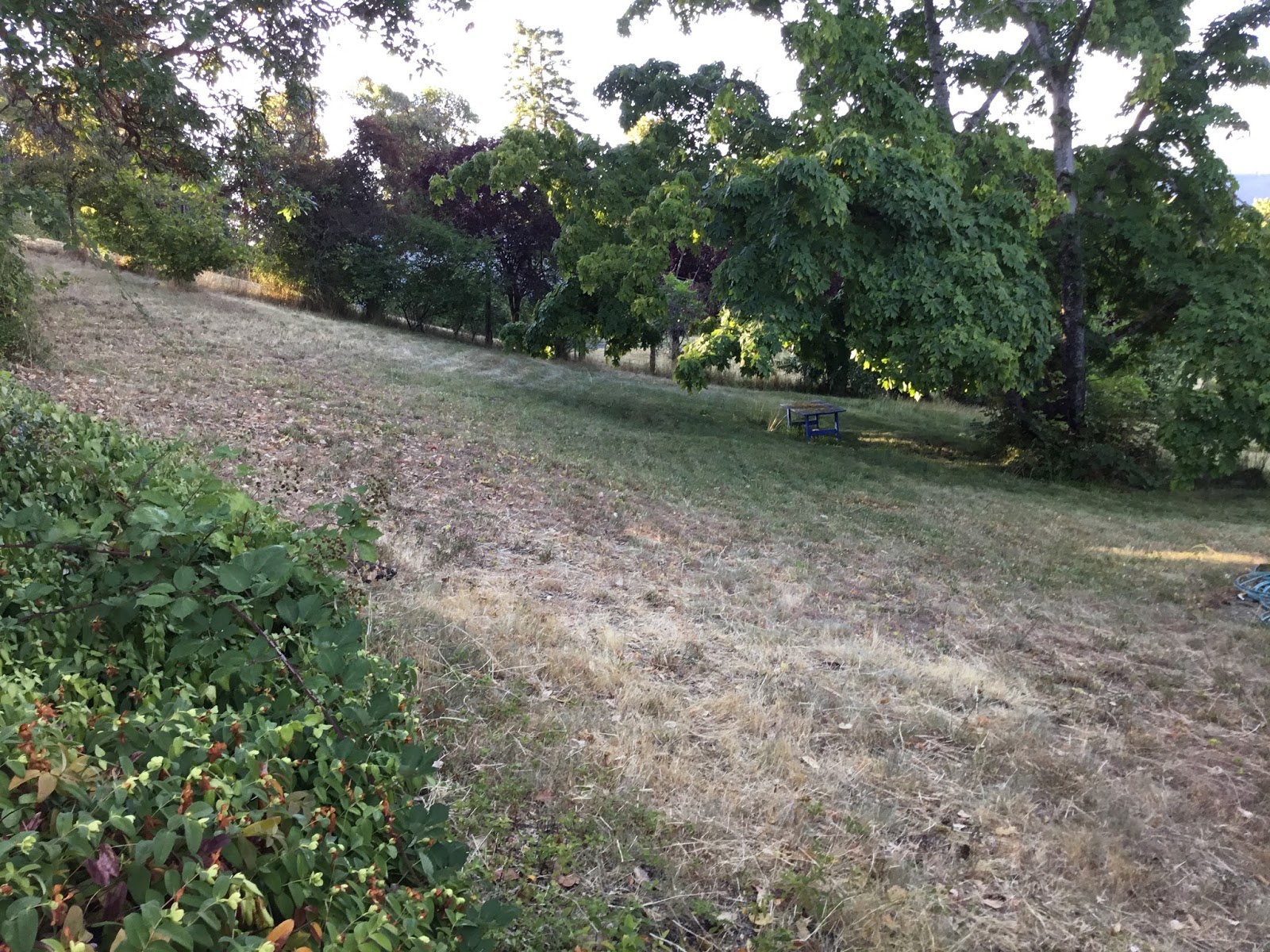
This is what the front yard of our place looked like before the lawn-mowing. The neighbour's house is in the background.

The neighbour across the road from us, an artist, thinks this display of wilderness outside our front gate is quite beautiful.

This neighbour's place has always been meticulously maintained. Recently sold, it has gone to weeds, and a newly planted fruit tree (you can see the tag) is dying for lack of water.

This is one of the reasons we had to drop the idea of letting our garden go wild. Blackberry brambles like this would soon take over. This bush gets cut back every year and comes back stronger than ever.

Another view of John, mowing, mowing. Notice his sun-protection hat.

Mr. Darcy looks unamused in the window. He liked the tall grass.

More naturalistic gardens are a thing, I read this spring in a gardening magazine. Allow more native plants and wild areas, it urged, and do less mowing and organizing. Surreptitiously, the idea took root; I stopped ripping out the orange and yellow poppies that proliferate in my Dunbar garden. Some flox and daisies I never planted elbowed their way into a garden bed.

But that’s just a city lot; a bigger idea was beginning to loom for our half-acre on Saltspring. It all began because John, who usually mows the grass there every three weeks, had skipped a time or two. Anticipating the big job ahead, he began wondering why we – he – cuts the grass on Saltspring anyway. Why, he wondered, on our recent ferry ride over to the island, don’t we just let it go wild?

The idea was reinforced when we got there to see that our neighbour’s recently-sold property, which had always been meticulously maintained with the help of a ride-on mower, hadn't been mowed for weeks. It had a fine crop of puffy white weed-heads. When we asked our neighbour on the other side whether she’d hate us for not mowing our lawn, she laughed. “It’s the country,” she said. "Let it be.” An artist herself, she asked specifically that we leave the weeds between our fence and the road, which she found quite beautiful.

Our Saltspring lawn is mainly different varieties of weeds – the only real grass is under the shady trees in the lower part of the property. Even so, in its own golden brown and tangled way – spotted with the ubiquitous yellow weeds that thrive in drought – it is quite beautiful. Just as the magazine article said, nature creates its own kind of charm.

But when we toured our wild garden, doubts set in. Walking through knee-high weeds is hard work. You end up with jagged little seed-bits in your socks and shoes that bite you with every step. Plus there are the blackberry brambles, which would soon take over the entire property (there’s a reason the place used to be called Bramble Cottage.) And with wildfires raging in the B.C. interior, the idea of letting all that fuel sit there in the sun seems a bit counter-intuitive.


 So despite the beauty, and how much easier it would be not to push a mower over half an acre of hilly land, John was back on the job soon after our arrival.  Our Saltspring garden, with its native bushes and untended areas, will always be far more naturalistic than anything that will happen in Vancouver. But unfortunately, if we are to make any use of it at all, we'll never be able to let it go completely wild.

The aftermath. This is the mowed version of the area shown in the top photo.

Here's the scalped front yard. At least there is lots of bush area left for critters (and Mr. Darcy) to hide in.

And the hillside. It may look bare, but at least we can walk it and pull out blackberry brambles as we go!


Friday, July 14, 2017

Building a dinosaur


Whenever my knitting friend Linda makes dinosaurs, people smile. She does, too -- it's one of the reasons making them is a pleasure for her. "It's creative and it goes quickly," she says. "You put it together and you end up with something that makes you smile." There are other reasons: she loves working with the beautiful saturated colours in the Kureyon yarn, made by Noro, a Japanese company, that she uses to make the toys. "It's wonderful to hold these colours in your hand." And because the yarn is multi-coloured, the end result is always something of a surprise. "It's endlessly fascinating; you don't know how it's going to come out." As well, knitting is meditative. And making small objects that people enjoy creates a sense of accomplishment in a crazy world.

One of the reasons people notice the dinosaurs so much is that they are unusual, with their odd shapes and angles. No wonder; dinosaurs themselves are unusual, with their strange appendages -- triangular plates along the spine, a bony frill around the neck, three horns, and a gigantic bone-crushing jaw. I've always been curious about how Linda incorporates these features into her toys, so when she made four dinosaurs for a relative recently, I asked if she'd document the process for me.

Here are her photographs from her creation of  two stegosauruses, one triceratops and a Tyrannosaurus Rex: 

In the beginning, there's the Fibre Fill for stuffing, the yarn, and the needles making a start on the body.


The stuffing begins. Double-pointed needles are used for knitting in the round, the same technique as for knitting socks. The body, neck and head are one piece, with stuffing added as the knitting progresses. The body narrows at the neck, which makes stuffing tricky. The head is created by increasing and decreasing stitches and other shaping techniques.

The triceratops in pieces, before assembly. Body to the left,  tail at the bottom, neck frill in centre, legs at right.
All assembled. Notice the three horns added to the head.
Front view of the completed triceratops.
The pre-assembled parts of a stegosaurus. Body at left, tail at bottom, legs in the middle, triangular spine plates at right.
Assembled stegosaurus.
T. Rex with his white grin.
The two stegosauruses, one green, one blue.
The four dinosaurs all together..
A frontal view of the herd.
The back view: the herd says goodbye.

Tuesday, July 11, 2017

Didion's prophecy

When writer Joan Didion trawled the American South in the summer of 1970 for an undefined tale she thought might be there, the icon of California cool was as out of place as a fish out of water. Her bikinis attracted attention in the motel pools she frequented; a New Orleans dinner host couldn’t understand how her husband “allowed” her to consort with “marijuana-smoking hippie trash” for a previous story; and the women she met were so cemented into their worlds of marriage and housekeeping that they spoke a different language. “Drive where?” said one, bewildered, when Didion asked if she listened to the radio while driving. Indeed, Didion seemed so alien that a whole cafĂ© once came to a halt to watch her eat a grilled-cheese sandwich.

Didion never wrote the article she was considering, but her notes from that trip have just been published in a book called South and West. Why publish notes from nearly 50 years ago? Because, suggests the book’s foreword, written in December 2016 by Nathaniel Rich, Didion’s observations “read like a warning unheeded.”

“I had only some dim and unformed sense,” Didion writes, “that for some years the South and particularly the Gulf Coast had been for America what people were still saying California was, and what California seemed to me not to be: the future, the secret source of malevolent and benevolent energy, the psychic center.”  In other words, America’s future was not in liberal, forward-thinking California, but in the South, with its deeply entrenched prejudices, attitudes and adherence to the past.

In his foreword, Rich says there’s always been an expectation that Enlightenment values would eventually become conventional wisdom. But two decades into the new millennium, “a plurality of the population has clung defiantly to the old way of life.” They believe in armed revolt; their solidarity is only reinforced by outside disapproval; they think white skin should bring privileges; they resist technology and deny evidence of ecological collapse. “The force of this resistance has been strong enough to elect a president.”

California’s golden dreams were just that, he concludes, while the “dense obsessiveness of the South, and all the vindictiveness that comes with it, was the true American condition, the condition to which we will always inevitably return.”

No wonder Didion was overwhelmed by her visit to the South. She focused on the details  – the heat, the snakes, the poverty, the bigotry, the isolation – but somehow she knew an earthquake was coming. The story she was seeking has emerged at last.

* * *

To me, Didion's prose alone, regardless of subject matter, makes her work worth reading. Some excerpts from South and West:

In New Orleans in June the air is heavy with sex and death, not violent death but death by decay, overripeness, rotting, death by drowning, suffocation, fever of unknown etiology. . . . In the hypnotic liquidity of the atmosphere all motion slows into choreography, all people on the street move as if suspended in a precarious emulsion, and there seems only a technical distinction between the quick and the dead.

One afternoon on St. Charles Avenue I saw a woman die, fall forward over the wheel of her car. “Dead,” pronounced an old woman who stood with me on the sidewalk a few inches from where the car had veered into a tree.

In Coffeeville, Miss., at 6 p.m., there was a golden light and a child swinging in it, swinging from a big tree, over a big lawn, back and forth in front of a big airy house. To be a white middle-class child in a small southern town must be on certain levels the most golden way for a child to live in the United States.


The snakes, the rotting undergrowth, sulphurous light: the images are so specifically those of the nightmare world that when we stopped for gas, or directions, I had to steel myself, deaden every nerve, in order to step from the car onto the crushed oyster shells in front of the gas station.

Monday, July 10, 2017

A mini-holiday


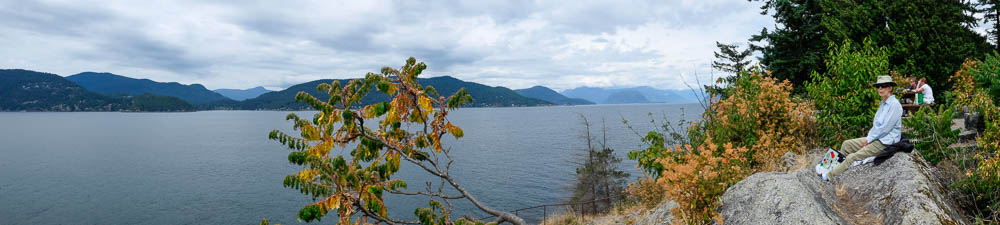
It's hedge-trimming time in our back yard. The noise is horrible. So John and I escaped on Monday to Whytecliff Park in West Vancouver. This panorama shot by John illustrates the opposite of sitting in our living room listening to hedge-trimmers. 

My nephew Etienne and his young family have reacquainted us with the concept of picnics. So we packed up a salad and some biscotti, put them in a carryall, and ate lunch watching the boat traffic on Howe Sound. 

This is Whyte Islet, attached to the park's beach by a rocky causeway. Even though John grew up in West Vancouver, he has never been at the park at low tide, when  you can walk the causeway to the islet. So on Monday, we did.

John climbed the islet to see what was there. A 360-degree view, a group of picnickers,  and a picturesque tree is what he found.

This tree is so perfectly located it's hard to believe it's for real.

Visitors making their way down the rocky islet. It looks easy, but parts are tricky to navigate.
It's a bit hard to see, but one woman decided it might be easier to come down on her bum. We saw one man kick off his flip-flops and use his bare feet instead.

John makes his way down the slope without trouble. 

After our islet adventure, we walked out of the park and down a nearby street to another beach. Mountains, ocean, bare logs -- a classic West Vancouver scene.

John on the same beach.
Back from our little jaunt into another world, we find evidence of the tree-guy's work. Bill will be back Tuesday to continue the job.

Laurel leaves on the walkway by the house. Bill will haul all the debris away when he's finished.
The space between the little boxwood hedge and the laurel is full of trimmed leaves. Nice job, but when the hedge trimming resumes on Tuesday, where we will go to escape?

Sunday, July 9, 2017

Essay wars

“If you are not struggling,” our professor told us when it came time to write our first essay, “something is wrong. It’s supposed to be hard work.” A writer herself, she was addressing the wide assortment of students who had decided, for whatever reason, that a master’s degree in liberal studies was the next thing on life’s agenda. We were nurses, teachers, administrators, lawyers, artists, engineers, nutritionists, and journalists, and for all of us, her words turned out to be true. Writing the course essays was always like going into battle.

Since that first class three years ago, I have written essays about duty, community, colonialism, progress, realism, Marxism, environmentalism and feminism. I have explored aspects of Roman history, the novels of Charles Dickens, Margaret Atwood and Virginia Woolf, and the impact of the French revolution on Parisian society. I have written a lot of essays, and each was a struggle.

So, the idea of going back to my journalistic roots and doing a profile of a little theatre for a course on the arts scene in Vancouver seemed like a slam dunk. What could go wrong? The theatre itself was perfect for the story, and the people I had to interview were wonderful – never did a news reporter have such co-operation! But combining journalism, academic material and my own opinion about it all turned it into one of the, shall I say -- most intense -- essay-writing battles to date.

But the prof – ironically the same one who told us essays are supposed to be hard work – liked it. Thanks to her, it’s been published on the Ormsby Review, an online site described as “a new journal for serious coverage of B.C. literature and other arts.” Another battle won, and just a year’s worth of essays to go!


Friday, July 7, 2017

Mr. Darcy's chicken coop

After our cat Mr. Darcy was attacked by coyotes, I wanted to let him sit outside in the evenings without being able to wander. We nailed chicken wire to three sides of the back porch and built a door covered with chicken wire.

Mr. Darcy's cage from the inside, with the door held shut by a wooden slot and a plant pot.

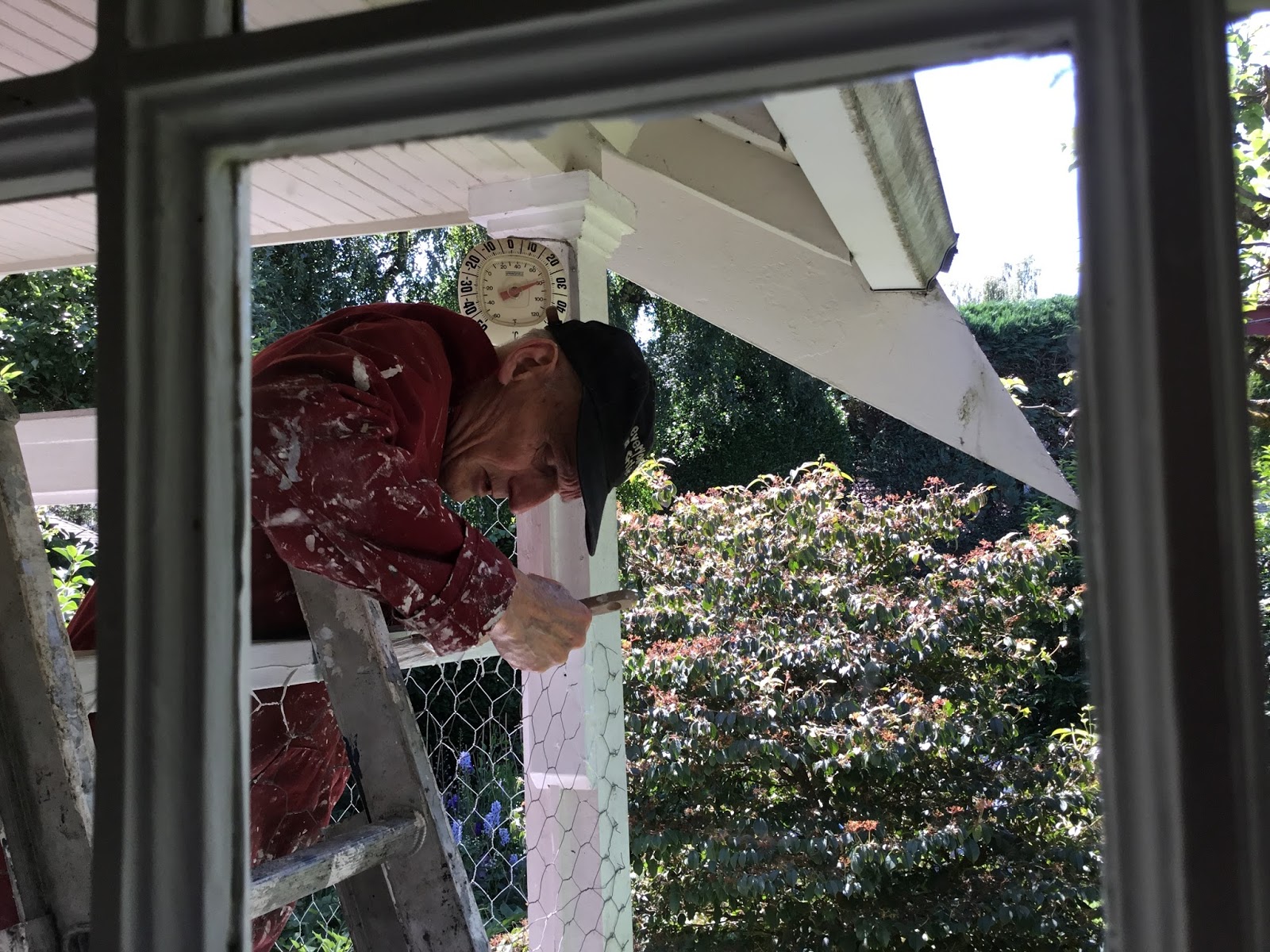
The wood frame supporting the chicken wire hadn't been painted until this week. John does his magic.

The removable door leans against the apple tree, waiting for its next coat of paint.

John in full painting regalia; he's used these coveralls for painting since we bought the house in the mid-1970s.

When we first nailed up the chicken wire on our back porch in 2013, it was just an experiment. A halfway place for Mr. Darcy – then recovering from a coyote attack -- where he could be outside, but still safe from the hazards of the great outdoors. Amazingly, the experiment worked.

Four years later, our primitive contraption – wire attached to wood railings partway up the porch and a removable wood-and-wire door held in place by a wooden slot and a plant pot – is still working. Mr. Darcy sits out there most evenings, sniffing and staring, after he’s been lured in for the night to avoid further coyote mishaps.

While I’m just happy with anything that keeps my cat safe, the unpainted wood was getting ratty after four years, and John has never liked the chicken wire. It looks, he says, “like a chicken coop.” We contemplated nicer-looking wire. Or wood latticework. Maybe hinges on the door so it would swing instead of having to be lifted in and out.

John was painting the back porch this week, so if ever, this was the time for a giant leap forward. But. The chicken wire is lightweight and see-through, while lattice would be heavy and block the view. And with a porch as old as ours, who knows what problems a hinged door might cause?

We solved our dilemma the way we usually handle household-improvement issues -- with minimal intervention. A coat of white paint can work wonders, we discovered. The ratty wood disappears when it’s the same colour as the rest of the porch, and everything is so fresh and white that you hardly notice the chicken wire at all.


An experiment that works is a beautiful thing; why mess with it?

As usual, we chose the simplest solution possible to improve the look of our cat cage: a can of white paint. 

Another shot of John at work. He's painting the rail that supports the wire three-quarters of the way up the side of the porch. 

Painting the door in the shade of the hedge and the apple tree.

The wooden slot the removable door fits into when Mr. Darcy is in for the night.

On the other side, a plant pot to keep the door closed. So far, it's worked fine. 

Tuesday, July 4, 2017

How to build a community

It all started with an odd-looking garden bench with a welcoming sign. By the time I got to know more about it, I discovered a circle of connections in a little Point Grey neighbourhood.
This is the garden that surrounds the odd-looking bench. It's full of luscious vegetables.

This is Blackie, the man who built the bench and garden. He got things happening.
 It’s easy to feel discouraged about community in Vancouver, with friendly old homes and neighbourly gardens disappearing, longtime local stores closing and entire blocks of gargantuan new mansions left sitting empty.  Sometimes, though, you come across a ray of hope.

I found one this week in tony Point Grey, of all places. That’s where I met Blackie, vegetable grower, seat builder, agricultural consultant, in the midst of the lush greenery of lettuce, beans, spinach, carrots, garlic, potatoes, squash and, yes, flax, that covers every inch of his boulevard and front garden. I had noticed his place before, mainly because of its unusual garden seat. It wasn’t just a seat, but a seat with four-by-fours at each corner rising to about eight feet, with cross beams joining them at the top. There was no roof, but one of the cross beams held a hand-lettered sign: “Sit a while!”  It was welcoming, but also, odd.

I was interested in the seat -- why the height? why the sign? --  but gardeners like to talk about their enthusiasms, so first I learned about the flax, a bed of feathery green running the full width of the boulevard. He grows it; a friend from the Netherlands threshes it and gives him – he makes a gesture the size of about three cups – a portion of the harvest in return. Flax blossoms last just one day and flower in the morning, he says, so if I want a picture, come back about 10 a.m. – “it's a mass of blue.” Then on to growing vegetables and the questions he gets from passersby: “There are people,” says Blackie, a friendly looking man who runs a blog for his motorhome community, “who don’t know what carrots look like.”  The deliciousness of home-grown vegetables is such that the people next door – he gestures to an Asian-looking young man wielding a wheelbarrow in the front yard of the house beside his – are going to start gardening themselves. “I gave them some of my lettuce,” he says. “Their son loved my lettuce. And now they’re going to grow their own; for him.”

 
The flax booming in the background; beans in front on Blackie's boulevard at 11th and Blanca.

The lettuce that convinced the next-door neighbours to start growing their own.

As for the seat, he built it for a man in his 90s who used it for a rest stop on the way to the nearby shopping area, he says. “But I haven’t seen him around for awhile. He may be gone.” Both of us, grey-haired and in our retirement years, contemplate mortality for a moment. Blackie says he saw the old man struggling to stand up one day, so he added a handle to the bars of the seat, “something to hang onto.” Sure enough, when I look, there’s a solid old handle there.


The handle Blackie installed to help a neighbour stand up.

 I learn the reason for seat’s high bars and crossbeams when Blackie begins watering his garden. The whole seat is a watering device: A pipe runs up one side, to a high pipe attached to the top of one of the bars. From way up high, it rains down a drenching spray on the garden beds below.


The seat has a white water pipe running up the side, to the left of the picture. It connects with another pipe on top.

After adjusting the nozzle on his water pipe, Blackie steps down in the spray.

When I return in the morning to photograph the blossoming flax, I meet the young Asian woman who lives next door. Her English is accented, but I understand from her that yes, they’ll be building a garden like Blackie’s, inspired by his vegetables. The children found them so delicious, she says. Besides, she gestures to her barren front yard, it’s nicer for everyone to see plants when they pass by. “For the people,” she says. “It’s better.”

As we chat, she waves to a neighbour pushing a wheelbarrow toward us up the street. “He’s going to help us,” she says. “He will make the beds.” Sure enough, the wheelbarrow is loaded with power tools. The neighbour, a tall man who looks like he could have been a banker in younger years, is taciturn, but when I ask about building the beds, he says of the young couple: “They don’t have any tools.”


The power tools arrive in a wheelbarrow.

 Blackie's neighbours have decided they want a front yard like his. 
In this divided city, then, a neighbour builds a seat for an old man, with a handle to help him get to his feet. He shares some vegetables with the young family next door, who are inspired to imitate him, not just for the food, but for the beauty of his garden. Another neighbour hauls his power tools up the street to help the young couple get their garden started. I don’t know the inner workings of this little world – how everyone met, the intricacies of these arrangements – but from the outside anyway, I see community.

The next-door boulevard, soon to be a luscious vegetable garden.

A close-up of Blackie's flax in bloom.

Sunday, July 2, 2017

The importance of hello

Our friends and neighbours at Vesuvius Beach on Saltspring Island. A new book by Yale professor Timothy Snyder says history shows one way to guard against tyranny is to reach out to people and make friends.
After we bought our cottage on Saltspring Island, I was surprised when John – as much a city person as me – started breaking city rules by issuing warm greetings to complete strangers. “Hello; how are you?” he’d ask when we encountered strollers on our neighbourhood beach. We met many of our beach friends that way – but it it took me awhile to get used to this new behaviour. Years of living in Vancouver had taught me the fine art of simply not seeing people.

According to a new book that’s turned into a New York Times best seller, John had the right idea. “Make eye contact and small talk,” is one of 20 lessons we should learn from the horrors of the twentieth century, writes historian Timothy Snyder in On Tyranny. It’s not just being polite; it’s a way of defending ourselves from the kind of tyrants who flourished in Nazi Germany and eastern Europe – and even now may be laying the groundwork for taking over in the United States.

 Snyder does not mention Donald Trump by name, but it is clear it is his rise to power that has prompted his warning. “We are no wiser than the Europeans who saw democracy yield to fascism, Nazism, or communism,” he writes. “Our one advantage is that we might learn from their experience.”

As for acknowledging the people we meet, Snyder sees it as “part of being a citizen and a responsible member of society.” It’s also a way to stay in touch with our surroundings, break down social barriers, and figure out who to trust. “If we enter a culture of denunciation, you will want to know the psychological landscape of your daily life.”


When victims of repression write their memoirs, none forget how their  neighbours treated them, he says.  “A smile, a handshake, or a word of greeting – banal gestures in a normal situation – took on great significance.” Similarly, gestures of rejection raised fear.  “You might not be sure, today or tomorrow, who feels threatened in the United States,” he writes. “But if you affirm everyone, you can be sure that certain people will feel better.”

Our idyllic Saltspring beach seems a long way from the horrors of the twentieth century; but just in case, it certainly doesn't hurt to learn to say hello.